Monday, November 6, 2023

Icewind Dale Remix Notes (Chapters 1-5)

Almost three years ago, I ran an online campaign of Icewind Dale: Rime of the Frostmaiden, WOTC's published campaign. I documented the first few sessions here, but didn't keep up with it (just like I haven't kept up with the documentation on any of my campaigns since Castle Xyntillan... sigh [EDIT: my AD&D campaign is being very well documented!]), though it ended well enough after a little under a year of play. 

Just now I got an itch to revisit it. While I've used published material before (the Ptolus sourcebook for 5e, Castle Xyntillan, various published adventures for Legend of the 5 Rings), that remains the only time I've run one of these big, campaign-spanning adventures. It also existed in this very productive space where it was good enough to care about and flawed enough to critique. 

So I've decided to go through and 'remix' it. I'm taking inspiration here from both Justin Alexander's Remixes, especially his treatment of Descent into Avernus (which also finished three years after the release of the original!) and Joseph Manola's Condensations of Paizo adventure paths. This is going to be somewhere in the middle between the two, offering both my opinions on the design of the adventure as well as modifying and condensing it, without being nearly so thorough or detailed as Alexander. 

Character Creation and Reaching Ten Towns

Icewind Dale starts out with character creation options: expansions on the standard backgrounds, the goliath PC race, and secrets. The latter is neat: every PC gets a secret from a list (possibly randomly assigned, possibly chosen from a selection). Now, some of these aren't really what I would call 'secrets' like the one that infects a character with slaad eggs, but a bunch of them are quite neat, add some campaign-specific flavor, and work to make the characters just a bit suspicious of each other. That last objective doesn't seem to stick around, as the rest of the campaign is not especially oriented toward intra-party intrigue, but it's a nice touch. It's a progression from the 'secret' mechanic in Descent into Avernus, published the previous year, in which the whole party is bound by a particular secret, and which by all accounts doesn't work very well. 

Kill it with fire!

Cold Open

After character creation, the game advises starting out with a two-paragraph narration about the state of the Dale, after which the PCs arrive in one of the towns and get either Cold-Hearted Killer, or Nature Spirits, or the local quest. The adventure punnily calls this the 'Cold Open.'

Punny, and wrong, and a waste, since an actual cold open would work quite well here.

Ten Towns Overview

The first section of the campaign is expected to take place in Ten Towns: a collection of settlements nestled among a few lakes in the middle of the Dale. Each town has its own quest, and there's a default assumption that the early campaign is going to involve traveling from town to town and picking up each quest until characters get to high-enough level that they can journey out into the far wilderness. 

The adventure nods toward the possibility of starting the campaign in any one of the towns, but this is, to put it delicately, less than fully supported. Several of the town quests, such as that for Easthaven, are probably TPKs for a first level party, assuming the mindset of 'fight everything and never run away.' More to the point, this sort of campaign makes the most sense if at least some of the player characters are foreign to the Dale, entering for the first time during the long winter. Following that, it also makes the most sense to simply start the campaign with characters entering the Dale, in which case it is natural for the first town they enter to be Bryn Shander, the gateway to Ten Towns and, apparently, the only town with a road leading to it from the outside. It also helps that Bryn Shander's quest is supposed to introduce the party to the blizzard mechanics and features a fight against a crew of goblins, as opposed to, say, a hag and giant skeletons. 

It wouldn't surprise me if at some point in development, Bryn Shander and its quest was the default introduction, but got folded in out of some desire to be more sandboxy. As much as I like sandboxes, and as much as it's a good thing that WOTC tried to move in that direction (we'll see how it broke down later), I think this was the wrong call: sandbox does not mean 'no guidance', nor does it mean 'lack of a strong introduction.'

What I did

I replaced the not-so-cold open from before with something of my own: the PCs (some locals returning to the Dale, some foreigners coming for the first time) journey into the benighted land. 
Two days ago, your wagon crested the Spine of the World. That was the last time you saw the sun. For just a few hours around noon, the sky turns to twilight. After that, there’s just the stars and the waxing crescent moon bearing down on you. 
Caravans in and out of the Dale are rare nowadays, and you ended up sharing the trip with a wizard and his bodyguard. He introduced himself as Dzaan, and his bodyguard as Vetala. Luckily, his magic has kept the covered wagon warm and cozy despite the deadly cold outside. 
With little to do on the trip through the mountains, he explained to the party how he was chasing rare elemental spirits called chwingas, and offered the party a deal. 25gp and a magical lantern in exchange for a live chwinga.
Dzaan is an NPC that shows up later, and I decided to give him some relevancy early on, both to consolidate a few questgivers into one, make it more impactful when the PCs find his clone, and give the Arcane Brotherhood a bit more presence and weight. 

Then the sled stops: there's another sled blocking the road, headed in the other direction: a pack of 4 wolves is gnawing on the bones of the driver and sled dogs. The party may fight off the wolves (as mine did) but they can just as easily scare them off with some fire, loud noises, and offering some rations. This is not supposed to just be a combat encounter, but one which sets expectations: Icewind Dale is characterized in large part by hunger. 

The driver is a man from Bryn Shander named Jericho, and he was killed with a spike through the heart, not by the wolves. His sled is too lightly supplied to be making a trip over the Spine, but there's nothing else for him to be doing headed in this direction. It looks like he was making a run for it. There are prints nearby, fresh in the snow, but they're quite far apart, as if the person making them could jump clear across thirty feet of snow and land soft as a feather. They lead straight to the gates of Bryn Shander, both ways.

As much as I whinge, gotta love the art

Intro Quests

The other wrong call here surrounds the wandering quests: there are two quests which the PCs can get right out of the gate which explicitly exist to encourage them to move from town to town, Cold-Hearted Killer and Nature Spirits. This is a good decision, and can help initiate players into a sandbox attitude; this was one of the much touted gimmicks of the campaign for a reason. 

Which makes it very difficult to understand why the campaign explicitly recommends using only one quest, not both. One is a lighthearted quest about searching for whimsical snow fairies, and the other is the search for a serial killer, so maybe this can be justified as a dial for GMs to set their campaign's tone, but it doesn't land for me: a lot of the campaign's best bits juxtapose the apocalyptic winterland with the absurd and whimsical. Every commentary on the campaign I've read has called this out, and recommended using both. This has benefits with juxtaposing two tones productively, and also makes sure the party has a reason to check out more towns. 

That said, there are some weaknesses here. In both cases, the introductions to the quests are pretty weak; both start with the party being approached by an NPC who hires them for the job. This makes some sense for Nature Spirits, but not for Cold-Hearted Killer. In the latter case, here's how it gets introduced:
Out of boredom and a sense of moral decency, Hlin has taken it upon herself to investigate the recent murders because no one else-not even the Council of Speakers-can be bothered. Hlin is studying the characters closely, trying to decide if they're worth her time. Ultimately, she takes the chance and draws them into conversation, asking them to help her take down her only suspect: a man named Sephek Kaltro.
Yawn-o-rama. 

There's a seed of something good here, in the subtext. An upright but desperate citizen who has failed to get the local authorities to move turns to the newcomers. It implies that Icewind Dale is a place where justice has fallen to pragmatism, possibly even one where the authorities conspire with the serial killer. But none of this is borne out by the quest as written. There's no sense that the fearful citizenry might try to stop the PCs from investigating, or that the authorities might apply any pressure. 

Instead there's just...apathy, 'no one else can be bothered.' The read aloud mentions how much gossip there is about the killings, but not mention of anyone else looking into it, measures people are taking to defend themselves. 

Not to mention that the boxed text sets up a faceless serial killer, but the questgiver comes out and correctly identifies him before the PCs have a chance to do any investigating (yes, the book says explicitly that this is a hunt, not a murder mystery: I still think it's the wrong call)! This is doubly silly because one of the major complaints about the campaign's first chapter is that Sephek is a tough combatant who stands a good chance of slaughtering a first or second level party, even alone and against freshly rested PCs. Laying out an investigation with each town providing, or having a chance to provide, some clue, going to the towns where the serial killer has struck and investigating there, asking after the friends and family of the victims, all of this would have the benefit of both building tension, engaging the players with an actual investigation, letting them think for themselves, and letting them level up a bit before facing him down. 

Nope. I know who the serial killer is, but somehow nobody else in this extremely paranoid and fearful tavern obsessed with the killings will believe me. Really? I would expect the townspeople to be organizing witch hunts and forming posses, not meekly sitting by. Tomfoolery. 

What I did

I used both, and also made modifications to each. The party met the serial killer, Sephek Kaltro, in Bryn Shander as soon as they got in: he thought the body they were carrying was a bounty, and offered to buy it off them and take it the rest of the way. I replaced Hlin with the sheriff of Bryn Shander, someone in a much more plausible position to offer a 100gp bounty on a serial killer. The party never took a proactive stance towards hunting the serial killer, so he showed up to bite them in the ass during the White Moose quest instead. Good times. 

In my version, Sephek could hop bodies, and Velynne Harpell helped them put him down permanently. In reality, she imprisoned the spirit and put it toher own ends. This didn't really come up again in my campaign, but it might come up in yours!

I also consolidated some NPCs: instead of getting the Nature Spirits quest from Dannika Graysteel, they get it from Dzaan. Instead of just being approached out of nowhere, he gives it to them on the sled coming in to the Dale. Also, I made it a bit more sinister: when delivered, the chwinga was upset by Dxaan, who put it to sleep in order to 'study' it. The PCs didn't like that one bit, and this cemented Dzaan in their minds. 

Ten Towns

After the starting quests, the various Ten Towns quests take up the rest of the first chapter. I'll go through the ones that have something of interest. 

Bryn Shander: Foaming Mugs

I wrote about this quest intro in Stop Writing Lazy Quest Intros, which just about tells you what I think of it. I'll recap briefly: if a bunch of pathologically trusting NPCs approach the party out of the blue and offer a bunch of money in an easily concealed form in exchange for a dangerous job, they're either doppelgangers or they can't complain when the PCs mug them. 

Also, this quest involves journeying out into the tundra to retrieve a shipment of iron ingots, but the reward is worth more than the ingots are. Now, that's not strictly bad, but you need to set up why that is: maybe iron is in short supply, and it's worth overpaying to get it back both so it can be turned into merchandise and actually make a profit, and/or because the reputation loss for losing the iron and the subsequent debt to the miners/smelters would be more damaging than losing gold. 

What I Did

In Bryn Shander, I moved the three questgiving dwarves to the House of the Morninglord, the temple/hospital, where they were recovering from injuries and frostbite after escaping the yeti. Since the party was bringing the body of Jericho here for proper rites, they encountered the dwarves quickly. It's more natural, and also builds up the environment as a threat. 

Bremen: Lake Monster

Pretend the fishing table doesn't exist and it's fine. I folded the questgiver Tali into Dzaan, who gave this to the PCs right after they gave him the chwinga.

Hey guys! Room for me in there?

Easthaven: Toil and Trouble

Another underwhelming quest hook I complained about before. The captain of the guard sidling up to the PCs while a wizard is getting burned at the stake and hiring them out of the blue will never stop being funny. My players never visited this town, but the quest looks serviceable and having one of these relate to the problems of food is good. 

Good Mead: The Mead Must Flow

The quest itself is fine, but the 'election' afterwards is bare-bones and pretty heavily railroaded. I addressed this in more detail here

Lonelywood: The White Moose

Good overall, the Elven Temple is a standout adventuring location among these early quests. The presence of the mummy, which my players freed but never really used, makes me wish 5e had proper henchman rules. 

Targos: Mountain Climb

I have to rant about this one. The premise of Mountain Climb is that a group of adventurers seeking a nigh-mythical werebear climbed the nearby mountain of Kelvin's Cairn with a guide, but got ambushed by yetis. So far so good. The guide is barely hanging on to life, and the only escapee is his dog, who goes to get help for its master. Okay, I'm interested, players tend to love loyal animals like that too. 

Now, put yourself in this dog's position. Your master is likely to die soon, and you need reliable help fast. Where do you go? Maybe down the mountain to the town of Caer Konig, which is the location of Frozenfar Expeditions, the company with which your master is contracted and from which the exploratory group set out? You know, the place which is nearby, inhabited, known, and which has people that will understand what has happened and have the expertise to mount a mountain rescue?

Or do you instead run across fifteen miles of dark, open tundra to get to the town of Targos, where your master's house and husband are, only to run to the first group of heavily armed strangers you come across and drag them to that house so that they can mount a rescue... maybe. 

Yeah, this hook just doesn't work if you have the map open. I moved this quest to Caer Konig and replaced it with an investigation into an underground Targos fightclub modeled on the WWE where the PCs were promised stardom by halfling Ron Jeremy and the druid developed a crush on the headliner, a goliath brawler named the Monolith, who beat him up. Good times. 

What I did

On Kelvin's Cairn, I added another room to the yeti cave, a control room for an ancient anti-spelljammer laser cannon hidden in the peak of the mountain. It has three shots left, can target anything above the horizon (like, say, a flying dragon), and can be controlled manually, though it still has functional targeting systems that strike at spelljammers that come in range. This comes up later. 

Chapter 2: Icewind Dale

After the party hits level 4 (which, given milestone leveling, is equivalent to doing five of the ten town quests), they are supposed to stop advancing by doing town quests (though they can still gain reputation) and should instead be turned toward the quests out in the wilderness of the dale. 

This division between the more-or-less civilized region around Ten Towns and the dangerous wilderness beyond is a good one, though the hard boundary here is less desirable. I'm informed that many parties chose to stick around and do all the town quests out of a sense of completionism. 

The big offender here is how these new wilderness quests are acquired. The book offers two options. The first is 'Tall Tales.'
By the time the characters reach 3rd level, they have garnered enough of a reputation that NPCs in Ten­ Towns will share tall tales with them. When the player characters are ready to explore more of Icewind Dale, use the Tall Tales in Ten-Towns table to entice them.
You can either choose which tales to share with the players, or you can ask each player to roll once on the ta­ble. Let the players decide which tales (if any) they want to investigate.
I recognize that the writers wanted to add some flavor to the hooks, but it doesn't work. First, all the information in these 'Tall Tales' is completely accurate. Second, the above level requirement ensures that the PCs won't hear about these quests/locations until they're almost ready to go out and do them. To the contrary, you'd want the PCs to hear about this stuff early, before they're ready, so they can look forward to it, so they can wonder, maybe get in over their heads a bit. 

The other option is for an NPC to hire them to go to each of these locations and either run an errand or kill everything there. Mind you, the setups for these are much better than the ones before: the PCs have built up some name recognition by this point, it makes sense for people to come to them with problems. Even better, some of these 'errands' make a good deal of sense: given that the wilderness is dangerous, getting the PCs to bring supplies to a remote location and check up on someone (Black Cabin) or supervise the delivery of valuable and scarce whale oil (Angajuk's Bell), actually fits. These aren't revolutionary hooks, but they don't have to be, they're just effective and make sense for the setting. 

The other notable aspect of the wilderness setting is a random encounter table: the gimmick here is that you roll both for encounter and blizzard, and the chance of a given encounter changes depending on whether there's a blizzard. It's a neat idea, one I may steal. 

So why, when I go onto forums discussing the adventure, do I find the prevailing opinion to be against the random encounter table?

There's a pat answer in here, something something 5e play culture, but I'd rather not descend into self parody. Frankly, I think it's just because the wilderness encounters are not very well integrated with the other mechanics. 

To be sure, there's a lot to like about it: at least a third of encounters aren't straightforward combat, and many others are unlikely to attack immediately; a few lean instead towards negotiation or other interactions, and a couple really deliver a nice moment at the table (mammoth-riding giants outlined against the rising moon? Hell yeah!). 

Hell yeah!

The issue is twofold. First, the encounters are pretty frequent. The adventure recommends rolling 1/day, with half of days having one encounter, a quarter having two, and the remaining quarter having none. That variance does get us some distance away from players blowing all their resources on the encounter because they know there will only be one (the Vaarsuvius Problem), but they still don't tend to have much of an impact on the journey. 

This is rooted in the short-term focus of 5e, with very little room for mid-long term resource management. So long as the players survive the 1 or 2 wilderness encounters, they'll get basically everything back with a long rest. There really isn't room for a wilderness expedition during which player resources experience attrition on a scale longer than a single day. As a result, these encounters don't successfully add time pressure to travel, nor do they incentivize the players to seek out shelter to recuperate, nor do they meaningfully limit how far and how long the players can journey away from civilization. They're speed bumps, and if you roll them as expected, you will have a lot of them: even leaving aside the shorter non-combat encounters, and assuming the DM ignores some of the weaker encounters which wouldn't meaningfully challenge the players, you'll still be playing through a lot of combats which will be forgotten the next in-game day. Maybe you've gotten your players to the point where combat moves fast in that system, but my campaign was online, and my players dithered. Moreover, I had a limited number of sessions in which to actually complete this campaign. I dropped the wilderness encounters after the first few times they showed up. 

All that said, the bulk of this chapter is a bunch of keyed locations, basically small, 5-15 room dungeons. I'll note down the ones about which I have something to say. 

Angajuk's Bell
Didn't get too much play in my campaign, but still one of my favorite locations. The presence of an awakened sperm whale that can guide the party across the Sea of Moving Ice is a great addition. If I were to run this again, I'd add more things to do in that area. 

Black Cabin
Another standout, frequently discussed on forums owing to the many near and complete TPKs that occur here. The implementation and metaphysics is a bit wonky, but worth remixing, which is an exercise left to the reader. 

Cackling Chasm
Didn't use it, straightforward hack and slash. Also the town quest leading here is far too twee for my tastes. 

Cave of the Berserkers
Never ran this. Out of all the wilderness locations, the only one that I read and think 'ugh, that would be a pain to run.' Doesn't help that the whole 'chardalyn' element of the campaign doesn't appeal to me at all. 

Dark Duchess
Standout: a wrecked merchant ship used as a secondary hoard by an ancient dragon. Likely to put the players face to face with something they absolutely can't take on in combat. 

Id Ascendant
One of my favorites, though I changed the exact setup: the illithids wound up becoming player allies after some misunderstandings. In my version, the Id Ascendant only appeared after the players got to the top of Kelvin's Cairn and accidentally activated the Ostorian anti-spelljammer laser cannon secreted inside the peak, in a secret passage beyond the yeti caves. The ship got shot down and the players had a very good reason to investigate. Good times. 

Jarlmoot
Boring as written, and an uninspiring hook (pro tip: getting an NPC to lure the players out to a remote location to murder them doesn't really work if the PCs have only just met this person). I modified it by putting a stoner frost giant sage there who served as a mid-campaign lore dump and smoked with the players. 

Karkolohk
Interesting by virtue of leaving room for negotiation and also being willing to throw a large number of weak enemies at the PCs. Solid overall, though the premise is just a bit too cute. 

Lost Spire
Has the potential to meaningfully change the direction of the campaign, but Dzaan needs to be set up ahead of time. 

Skytower Shelter and Wyrmdoom Crag
These should be great, but don't really come together for me. I think it's because the goliaths don't show up elsewhere, giving them a strong presence earlier in the campaign could make these stand out. I think it's also because the more lighthearted elements of these locations clash unproductively with the apocalyptic horror of much of the rest (unlike some other lighthearted elements of the campaign, which highlight the horror). 

My Changes

I worked up a list of 20 rumors cobbled together from the existing 'tall tales' table, obfuscated the hooks, added in some entries pointing at the Ten-Towns quests, plus a couple of red herrings, and let the party roll on that table from level 1. No reason to prevent the PCs from actually hearing rumors until they get to higher level: you want to build some anticipation, let them know about possible adventure out in the wilderness they aren't ready for. 

Chapter 3: Sunblight

I've mentioned before that Icewind Dale starts out as a sandbox, and then stops. This is the turning point. 

Sunblight is a multi-level dungeon with thirty-odd keyed rooms, the hidden fortress of a duergar warlord set on taking over the Dale. 

Duergar have showed up in the adventure before, spying on Ten Towns and causing trouble. Now they are revealed to be massing in force, on the cusp of wiping out the towns entirely, and they are constructing a superweapon: a robot dragon! The PCs must go and... take on a whole fortress by themselves? The adventure states that they might want to launch a preemptive strike before the weapon is ready, which would be quite reasonable, but it's already finished, and it gets unleashed right as the PCs arrive.

The book thinks this will be an 'agonizing decision' between storming the fortress (the whole point of 4-6 homidical maniacs assaulting a literal fortress was that they can make the difference by sabotaging a superweapon) and chasing down the dragon before it can destroy Ten Towns. It's the sort of thing that would probably work at the table, but players would start questioning this series of events at the fridge later. The in-world assumption represented by the initial hook (a party isn't enough to take on the fortress, but you can stop the superweapon) runs up against the mechanical assumptions, which is that a party in the 4+ level range is going to be entirely capable of fighting the fortress by going room-to-room. Also, given the transportation options available, there's really no way for the PCs to get back to the towns before the dragon has torched a few of them, and assaulting the fortress just doesn't take that long in this system of 6-second combat rounds. 

There are a few other problems here, like the overly-cute plot about which dark god exactly is pulling the strings here and the rather unsatisfying inclusion of a faction within the duergar that... don't really do too much... but Justin Alexander has the details on those, and I don't want to just repeat his points. 

My Changes

I foreshadowed the duergar plot more, and reworked Sunblight's plot. In my continuity, the duergar king realized that this group of 4-6 nutcases were the single biggest obstacle in the way of his plans, and they could probably take down the dragon once it attacked the town they were in. So he sends some disposable agents to leak information about the dragon (they think it's still under development, but it's actually been complete for a while), thus luring the PCs, along with a large part of the overall Ten-Towns militia, out into the wilderness. The dragon gets released then, so that it can torch the towns while they are most vulnerable, and the majority of the fortress' people are already out near Ten-Towns, lying in wait for the dragon's arrival. I played Xardorok Sunblight basically as a Bond villain who waited for the players to arrive in his chamber to unleash the dragon, gloat, and reveal the dozen crossbowmen waiting in ambush. Good times. 

Jim, what's the CR on that thing?

Chapter 4: Destruction's Light

This chapter also features one of the more confusing elements of the campaign, which has earned a lot of criticism. 

As the PCs are leaving Sunblight (either because they decided to chase the dragon or because they're done with the fortress), they're approached by Velynne, a wizard on a dogsled who offers them a list back to Ten Towns to deal with the dragon. 

The catch is that the sled dogs are undead, and the wizard is accompanied by kobold corpses as well. She's a necromancer. 

As written, this is a jarring introduction to an NPC whom many players will want to kill on sight, doubly so when they find out she's a member of the Arcane Brotherhood, the faction of wizards who have been repeatedly set up as treacherous antagonists. Even worse, this NPC is plot critical and basically exists to hold the PCs' hands now that the campaign has turned into a railroad. 

I already added Velynne into the campaign earlier (in my campaign she warned the PCs about Dzaan's treachery and helped them deal with Sephek), so this problem is nullified. 

As written, this chapter kills at least a sizable portion of the Dale's remaining population and torches at least a couple towns, even if the players are otherwise maximally efficient. I have no problem with that, but this needs to be set up tonally beforehand. This ought to feel like the sort of place that's on the brink of destruction before the dragon shows up. 

Chapter 5: Auril's Abode

We come now to perhaps my least favorite part of the campaign. 

The Island of Solstice is a huge, snowflake-shaped iceberg floating in the sea, in the center of which is an ancient giant fortress shaped like a huge skull, named Grimskalle. Love it, sign me up to adventure there any day!

But, why is the party actually coming here?

Well, because the railroad says so. 

In-game, it's because Velynne wants to enter Ythryn, the ancient floating city which fell to ground and was covered by the glacier. She knows where is it, but needs a special spell to break open the glacier at the right spot, and needs a sentient magic item that contains information about the city. Both of these are on the Island of Solstice: the spell is in a book called the Codicil of White made by Auril's worshipers, and the item, called Professor Skant, was stolen by another wizard who made her way to the island and died there. How Velynne knows this is unclear, but it doesn't matter for our purposes. 

What's more relevant is that Auril lives in Grimskalle, physically, and will be there unless the party sneaks in while she's away casting her spell to shroud the Dale in night. The players can end the Rime here by killing Auril (very difficult) or by killing her pet roc, without whom she cannot fly into the air to perform the nightly ritual that maintains the endless night. Please note that we are two large dungeoncrawls away from the end of the campaign. 
Unless she has left the fortress to cast her nightly spell over Icewind Dale, the Frostmaiden lurks here in her first form, living in fear that her divine enemies will find and destroy her. She normally occupies the room to the west but lurches toward the larger room to greet the characters as they arrive. The characters have no chance of surprising her.
I actually forgot about this bit. I replaced this with my own headcanon so early in the campaign planning that I didn't realize it wasn't the canon approach, much to my surprise when I was rereading the book for this post. 

This is all very, very silly, but it gets sillier.

Recall, the PCs aren't here specifically to kill Auril, but to recover some items. The professor orb is next to the other wizard's frozen corpse in a random spot on the opposite side of the island. Not impossible to find, but a bit dubious. The Codicil of White is in the basement, behind the world's silliest security system. To get into the chamber of the Codicil, the PCs must pass various tests representing the ideals of the Frostmaiden: Cruelty, Endurance, Isolation, and Preservation. This is a neat idea. 

Here's how it works in practice. There are four doors in the basement. You can go through each one, and you get teleported to a nomad tribe on the glacier which is presently experiencing a crisis related to one of the ideals. A couple are short (one is just a fight against a werewolf), while the others take a day and a week respectively. This is, apparently, actually happening in that moment, contrived as it is, and the adventure doesn't address how this is happening or how it is possible for multiple PCs to take the test asynchronously, as the book explicitly states can be done. The scenarios themselves are equally contrived, and if there aren't enough PCs who have passed enough tests, some NPCs come by to try to take it, opening the door in the process. Making all of this irrelevant. Now that's what I call a fragile scenario!

This section demonstrates that the campaign doesn't have a solid through line. Based on all the marketing, you'd expect the major conflict here to be the Rime. It's a situation which threatens everyone and makes the whole area almost unlivable but doesn't just kill everything immediately. 

But then the duergar show up, and they have no special connection to Auril besides opportunism, wanting to take over the now-dark surface. Then a dragon destroys between a little and a lot of Ten Towns, and you'd expect there to be some focus on repairing the communities or helping them survive, but no. In the last stretch it becomes a treasure hunt without any special connection to the Rime. 

This would be fine if RotF stuck to a sandbox structure past Chapter 2 and treated the Dale as a big situation that the party can't defeat with combat (until they realize that killing Auril ends it, but that ought to be really difficult). That situation can give rise to other symptoms, like a duergar invasion. Sandbox elements like allying with the goliaths and nomads can be pursued proactively to present a united front against these threats, and treasure hunts like the search for Ythryn can be attempts at finding solutions, or finding magical power to more effectively combat these problems. 

But since the campaign drops the sandbox structure after a while, that stuff is located in new school time rather than old school space, and the PCs are shuttled from one to the other without an obvious purpose. 

My Changes

In my campaign, I just removed the Frostmaiden from this location (her presence here no longer made sense in my continuity) and replaced the 'tests' with tests of my own. The players received dreams about the various ideals much earlier on in the campaign, and I tracked particular acts of cruelty, isolation, endurance and preservation they committed across the prior sessions. They had at least one person who had done each by the time they got to Grimskalle and made their way in without difficulty. 

If I were doing a more thorough remix, this is a section I would change up in the following way:

This is only Auril's Abode metaphorically. She doesn't physically live here. Rather, this is her temple, the headquarters of her frost druid worshipers, where she sometimes makes (or made) appearances to her most devoted followers. Most of the rooms can stay. The tests are more like my version than that in the book, ritual initiations which allowed worshipers to enter the inner circle of the cult. Each requires only that a person has committed some major act of cruelty, preservation, endurance or isolation, such that players who have done these things earlier in the campaign can come together to enter the secret chamber of the Codicil, which is not 'a primer on her worship' but a record of the revelations granted to the high priests of past generations. 

"This is where the plot goes."

Next up

The next post will cover chapters 6-7 and discuss the all-important question at the heart of the campaign: what does Auril want?

If this post interested you, comment below, share it around, and subscribe to the blog. Until next time, have an excellent week. 

Wednesday, November 1, 2023

AD&D Session 4: Thunderhead

In the last session, the Order of the Perfect Circle slew a 'dragon', caroused with the kobolds on the first level of Stonehell, and butted heads with the Cult of the Ultraviolet flame. Now they have been trapped in the quiet tombs of Stonehell. Will they find a way out? What treasures remain out of their reach, and what threats will they face? Join them in this week's journey to find out...

The Party

Norbeth Yelfiel, elf mage/thief with a periwinkle wide-brimmed floppy hat, played by Finn
Akiva ben Moshe, beetlefolk fighter with a short ponytail, played by Ali
Occam, goblin fighter with a greathelm, played by Anne
Agatha, human paladin with a smiling-masked samurai helm, played by Anne
Innus Entus, goblin cleric/fighter with a bishop's mitre, played by Cao Linh
Ingvar Duram, human cleric with an extravagant tricorn hat, played by Jackson
Eileen Longtail, human soldier
Precious, domesticated rat

Casualties
None

Loot
300cp
350sp
Golden ring (50gp)
200pp
Winged boots
Potion of healing
Brass ring (unidentified)
Acquaintance of sage, Eramay the Impassive
Some answers

The Game

25 Plantings 1113
  • As the Order of the Perfect Circle looted the tomb of the bone-thing, they spotted a torchlight coming down the long hall towards them, from the unexplored north. A heavily armored figure stood before them, with a masked helm bearing a smiling face. 
  • This was Agatha, a warrior who had come down to Stonehell alone, managed to push open the northern danse macabre door. When Occam heard this, he dashed north and headed towards the surface to see Tork, leaving the Order with Agatha. When they learned she was a paladin and established her love for circles, they were more than happy to include her in their expedition. 
  • They plundered the remaining tombs nearby, picking up no shortage of coinage and even a pair of magical boots with metallic wings on the ankles, and came to an intersection stuffed with fire beetles, feeding on goblin corpses. Akiva stepped forward and spoke to the insects in their own tongue, beetle-to-beetle, and negotiated safe passage and mutual non-hostility. 
  • At this point, Innus Entus determined he had contracted a nasty ear infection from his night's sleep in the kobold 'inn'. Faced with the opportunity to return to the surface, they decided to continue exploring the level. 
  • It wasn't long before the Order came to another cluster of tombs and set their looting system into action. But in these, the Order found bells next to the biers, where animate corpses could ring them.
  • The Order elected not to mess with them, but as they proceeded down the hall, powerful undead hands tore down the doors and the ringing of bells filled the mausoleum. 
  • The Order retreated to the mouth of the corridor, Akiva and Agatha holding the front. A swarm of shambling corpses and skeletal archers marched out of their tombs to crash into their defensive line, but they held fast for several rounds.
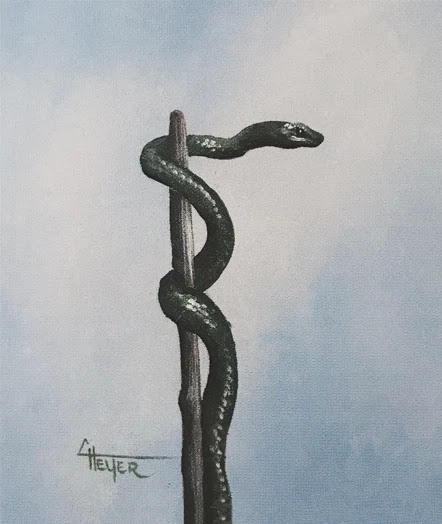
  • When the zombies had been cut down and only a contingent of archers remained, they heard a command from behind them. The undead ceased their attack and stood at attention as Numin, the leader of the Ultraviolet Flame cultists, with his serpent-headed staff, approached. Now getting a closer look at him, he wore the distinctive corpse-like face paint of the Death Nuns. 
By Carol Heyer (?)
  • He was keen to see why the Order had neglected his order to leave the tombs for the surface, until he saw they were now accompanied by a paladin. After a quick negotiation, he permitted the Order to pass and head for the surface unmolested. As they were departing, he caught a look at Agatha's face and was very curious about her ancestry, but a monotonous lecture on daily life in Beegrove sent him wailing back to his lair.
  • Back on the surface, the Order decided to put their newly acquired flying boots into action and scout the caves on the sides of the canyon: they determined many were filled with predatory animals, and that the waterfall cave had some strange mechanism hidden within it. They also discovered a secret room complex and recovered a strange brass ring scintillating with rainbow colors, whose use they could not determine. 
  • They also found a chamber filled with cold, necrotic energy, and a defaced insciption. The legible part read 'all rot and decay is a sacrament unto our lady--'.
  • Thereafter they departed Stonehell and returned to Beegrove, where they partied it up. 
4 Low Summer 1113
  • A week of carousing passed in the small town of Beegrove, during which Innus Entus was recovering from his ear infection, Agatha was falsely accused of stealing the Count's prized horse (a gift from the king!) and the parish priest approached Ingvar with a request: to look after a box during the time the priest was away, make sure it was safe, and not open it. Ingvar determined the container, no larger than a ring box, contained something small, no larger than a single coin, and was padded on the inside, but did not open it. 
  • After that week, they traveled to Clifton in order to track down clues to the Clifton heir's lost treasure. 
7 Low Summer 1113
  • The night of the Solemnity of the Implacable presence, they passed through the walled city of Blackstable, which was in the throes of its annual cattle festival. The Order ate a lot of good beef and had a generally enjoyable time. 
8 Low Summer
  • The Order arrives in the Clifton area, and starts hearing warnings about a vicious bandit group prowling the area, even going so far as to attack the mail wagon (usually left alone by brigands). At the same time, they spy a messenger gallop into town, give the sheriff a brief message, and ride down the road on a fresh horse. 
  • The alarm goes up. A hurricane is incoming! The townspeople start grabbing supplies and valuables and move to high ground in a frenzy, and the Order pitches in. 
  • The sheriff asks around for anyone willing to ride down the road to warn an isolated sage of the incoming storm. The Order volunteers, with Agatha taking the winged boots and double-timing it while the rest of the Order heads there at regular pace. 
  • Two hours of flight exhausts the boots for the time being, but gets Agatha to the remote hut... which at that moment is being assaulted by more than a dozen bandits!
  • Strong though the paladin was, she wouldn't come out on top against those numbers in a fight. Instead she stepped out of the treeline and bellowed out as intimidating a threat as she could muster. 
  • As she did so, an elderly woman threw open the shutters, shouted,
'My savior! Kill them all!'
  • and dumped an armload of sticks onto the assembled thugs, who screamed and fled as the sticks turned into snakes. 
  • This woman was the sage, Eramay the Impassive, unparalleled expert in human history and genealogy and dabbler in the supernatural. She was, in fact, unaware of the pproaching storm and set Agatha to work moving her most fragile and valuable possessions into a nearby cave which would shelter them. Once the rest of the Order arrived a couple hours later, they were enlisted in the effort as well. 
  • The bandits did not return, and as the wind began to howl, Eramay offered the Order a chance to shelter with her while the hurricane raged. They accepted, and spent the next four days in close quarters with one of the most learned scholars in the region. She offered them a single free question in exchange for their timely aid (a fair boon, given how pricey a sage's aid can get), which the Order used to decrypt the treasure map left by the Clifton heir. 
  • She was the right person to ask: not only was human history her field, it all happened in her own backyard. She identified two locations on the map as a selkie cove and the site of the old Clifton manor, long since abandoned, and quickly determined that the riddle's reference to 'the flock' referred to a mural of a flock of sheep, which abutted the stony hill against which the manor was built; doubtless the resting place of the treasure!
  • Eramay offered the Order another free question, if one of them answered one of hers... specifically, if Agatha told her about her ancestry. 
  • This was the second time someone had asked about this, and with some prodding, Agatha revealed she was descended from the Wicke family, a prominent merchant house from the south, recently fallen into disarray. Few knew that the Wicke family was involved in the construction of the Castle of the Silver Prince, and fewer knew that the Wickes had a congenital allergy to silver. 
  • In exchange for her genealogy, Eramay told the Order the story of the Silver Prince, both the fairytale they already knew, and the more obscure information they didn't. 
12 Low Summer 1113
  • The hurricane abated, and the Order emerged from hiding. The land was still being soaked in a rainstorm, but at least the wind was tolerable. As a rare spot of sun broke through the clouds, they spied the outline of a miles-high human face in the retreating thunderhead over the sea; as soon as they spotted it, it was gone. 
Will the Order find the hidden treasure of Haemedean Clifton? What strange secrets lie at the heart of the hurricane? And what shall come of Ingvar's mystery box? Join us for next week's session of Cascabel!

Takeaways

It doubt it comes across in the recap, but I was dissatisfied by my performance this session. 

The battle with zombies and skeletons in the corridor, which takes up just a couple lines here, took up a considerable portion of the session. 

When the players found a little mausoleum complex near the Stonehell entrance in session 2 (where they got the bag of holding), having undead next to each other like that was a novelty. When they found that same structure again in the quiet halls, it was like a little call-back; they knew what to do. 

However, by the time that second complex got sacked, it got old. The presence of Unquiet crypts scattered among them ought to partly alleviate that, but it mostly means the party sometimes has to deal with a few undead before they want to. Not really riveting stuff. 

I tried to make it more challenging by putting bells in some of the tombs, so undead could awaken each other and call for aid. That ultimately meant 20+ mixed undead waking up and coming towards the party. Not a bad thing, but I wasn't ready to run that. We use a grid whiteboard with 5'x5' squares, which is great for tracking PC location, not so much for tracking the location of that many swarming enemies. In addition, I didn't really move the undead in any strategic way, leaving many of them in their tombs. This was kind of deliberate and kind of not, overall it was a mess. The cultists appeared once most of the undead (out of the half or so I actually moved to engage the party) were defeated, mostly to keep the fight from dragging on after its outcome has basically been decided. 

It didn't help that I was rolling enemy type, number, hit points, and treasure in the moment, for a half-dozen different rooms. I should have taken a break to pre-roll those once I figured the party was staying in the area. 

I was also very silly in the way I was interpreting crypt results. When the result came up 'Empty' for Crypt Resident, I described the crypt as just being empty, no body in it. That's dumb! I should have made 'Empty' usually mean a non-undead body within, maybe an actually empty result now and again indicating an unusual unused or robbed crypt. I know this! But in the moment my good sense fled. What dumbassery. 

I also wasn't satisfied with my performance after the party left the dungeon. I felt my description of the caves and rooms on the surface was dull and rote. When the party was carousing and using downtime, I didn't leave them space to roleplay, and I was deficient in describing the travel from Beegrove to Clifton. I also felt like my description of stuff at the end was incoherent. 

Part of this is doubtless magnified by memory, but in large part it was just subpar DMing on my end. Thankfully, all the players from this session have RSVP'd for the coming one, so I can still make it up and improve going forward. 

Some changes I plan to make:

On my end, when I have large groups of homogenous monsters in the future, I'll treat them individually but move them in groups: let a large 10'x10' token represent a squadron of up to 9 hobgoblins, or a mob of up to 16 swarming zombies, etc. Then I can keep track of everything much more easily and feel confident in actually using these large numbers of monsters without throwing the rules to the wind. I will also, when situations like the corridor fight happen again, consider using average damage and to-hit chances and fast-forward the combat a few rounds at a time, stopping when something breaks the stalemate. 

I will also print out the list of carousing actions and leave the players time to figure that stuff out on their own and interact amongst themselves. The game works best, I think, when combat is the junior partner and exploration and roleplay are senior. This session did not have enough roleplay, though there was plenty of opportunity to create the space. 

I think I also just need to slow down, take a couple 5-minute breaks during the session to compose my thoughts and plan, and just generally slow down description so I can visualize and simulate, not just read off the page. Maybe Stonehell is too convenient, in a perverse way; I got comfortable just relying on the text. 

Saturday, October 28, 2023

AD&D Session 3: The Order of the Perfect Circle

In the last session, the party continued their delve in Stonehell, explored more of the first level and ventured briefly to the second, accidentally started a cult, and recovered great treasure. Will their luck continue? What more awaits beneath the earth? Join them in this week's journey to find out...

The Party

Sonari, elf mage/thief with a wimple, played by Jada
Norbeth Yelfiel, elf mage/thief with a periwinkle wide-brimmed floppy hat, played by Finn
Akiva ben Moshe, beetlefolk fighter with a short ponytail, played by Ali
Occam, goblin fighter with a greathelm, played by Anne
Innus Entus, goblin cleric/fighter with a bishop's mitre, played by Cao Linh
Ingvar Duram, human cleric with an extravagant tricorn hat, played by Jackson
Eileen Longtail, human soldier
Tork Longtail, ratling scoundrel
Precious, domesticated rat

Casualties
Tork (left for home)

Loot
12000cp
6000sp
50gp amethyst
1100gp jeweled circlet
3000+gp assorted jewelry
Kobold fan club
Appreciation of President Sniv
A name
Enmity of Salomon of the Ultraviolet Flame
Enmity of Slep, kobold guard captain
Lachesis' iron ring

The Game

24 Plantings 1113
  • When last we left off, the party had returned to Stonehell, explored the natural caverns west of the entrance, and looted a mausoleum complex, which rewarded them with a great haul. As they were identifying the items within the room of the skull altar, another group of explorers came upon the long-shut mausoleum door, now hanging ajar...
  • Luckily for the party, this group was the beetlefolk explorers they had met previously. Even better, their compatriot Ingvar Duram was still with them, hale and healthy, and rejoined the group. They had quite a lot to tell him about since they parted ways.
Party: There will probably be a schism in the Acolytes of the Perfect Circle when they realize the sun isn't perfectly round. 
Ingvar: The what
  • After Norbeth positively identified the bag of holding, the party discovered that it was not empty, but contained a treasure map. The sketched map clearly showed the region of the kingdom some distance to the east of Stonehell, but the text on the opposite side was a mystery. Luckily for the party, Ingvar was well educated and knew both Khaldean, the language of poetry and sophistication, as well as High Cascabel, the archaic language of the old nobility. The message was written in Khaldean script but using the High Cascabel language. 
  • It was a letter, written by the last heir of the Clifton family as he lay dying in Stonehell, addressed to two people named Jacinth and Simar. It urged them to escape Cascabel, retrieve a key secreted away with a selkie clan to the east, and recover the treasure he had hidden from the Potentate. 
  • The party decided to check it out after they were done with the current delve. In their continued explorations, they fled poison smoke that billowed from an ancient fountain, gambled on their lives with an esoteric stone wheel (Sonari got a permanent +1 to dexterity, Akiva was cursed for a day), Sonari and Innus Entus were both struck with the poison of a giant centipede, the party narrowly avoided a swarm of glowing-red fire beetles, and they established friendly contact with the kobolds of Stonehell (Ingvar's talent for languages came in handy yet again!). 
(Noting the kobolds' rickety ladders and equipment as they repaired traps)
Party: What's going on here? Where is KOSHA in all this?
  • While Sonari decided to head back to the surface to seek treatment for the poison in town, the rest elected to remain underground. But past the stairway chamber, they encountered yet another patrol of Festering Wound goblins! 
  • Unlike the ones they met in the past, these were on alert. One outpost and another patrol had been destroyed without warning in the north quadrant, where their enemies, the Wolf Gang, were not active. The goblin in front revealed the black, rotting wound on her ear, and demanded to see the same on the party's goblinoids to prove their identities. 
Occam: Mine's in an... unmentionable place.
  • The party braced for combat... until Innus Entus took off his shirt and showed them the untreated centipede bite on his shoulder.
  • The goblins were convinced, and informed the 'reinforcements' that in light of their missing patrols and the kobolds' continued support of the Wolf Gang, the Festering Wound was badly in need of funds to turn the tide. In their desperation, they had plucked up the courage to seek out 'Da Dragon' of which the kobolds were so terrified, and take its hoard. 
  • The party had passed through the caverns in which 'Da Dragon' was supposed to lair, and did not encounter it, though their contact with the kobolds, who were periodically assaulted by it, convinced them it did exist. They concluded that the Festering Wound were fools, but decided to take advantage of that foolishness. 
  • The two groups joined together, the non-goblin characters once again passing themselves off as war-slaves, and marched to the cave where 'Da Dragon' dwelt. The party convinced the goblins that since two of their war slaves, Ingvar and Norbeth, spoke the dragon language, they should go in first to declare the Festering Wound supremacy and act as meat shields. Of course, these two actually planned to ask leniency of the dragon and promise to aid it in killing the goblins. 
  • However, as the huge, reptilian figure dragged itself out of the pool at the far end of its cave, they found that 'Da Dragon'... was in fact a colossal, overgrown gecko. Which immediately charged forward. 
  • A great melee began, with Festering Wound goblins and 'war slaves' crossing blades with the lizard's talons as arrows and javelins flew from behind. Innus Entus covertly commanded some goblins to charge forward and enter melee, improving the odds for the PCs in close quarters. Ironically, the most serious blow dealt during the fight was Norbeth's stray arrow hitting Akiva for max damage (though only half his health, that guy is extremely tough), and the party had much better success than the goblins did in piercing the gecko's scales. 
  • The fight concluded with Akiva chopping off 'Da Dragon's head with a great overhead slash of his greatsword (the variant weapon damage against large creatures coming into play!). Against numerous and organized opponents, the lizard had dealt no casualties. 
  • As the goblins celebrated, Akiva retreated to Innus Entus and received the cleric's healing power. That was when one of the goblins nearby realized they had been had.
'Surface-worlders! Deceivers!'
  • The fight was joined anew, but most of the goblins were spread out, and those in the back of the tunnel were surrounded and quickly dispatched by the party. One was struck with Innus Entus' fear-inducing slap, and fled into the depths of the cave. Occam chased down and slew this one, and the rest were summarily slaughtered with arrow fire.
  •  In the quiet of the cave, the party discovered that the false dragon did in fact have a hoard. Though large in quantity, most was not especially valuable, but a valuable jeweled circlet more than justified the expedition.
  • They took Da Dragon's hoard and head, and returned with both to the nearby kobolds. They were overjoyed that this monster, that had eaten so many of their brethren, was finally defeated. They kobolds led the party straightaway to their home in the dungeon, too quickly for the party to make accurate maps, leading them without incident through the Festering Wound's territory to the south, past a set of barred passageways, and into kobold territory.
  • Along the way, Eileen alone heard an alluring call in the darkness, to which the kobolds responded by covering her eyes and ears and double-timing it in the other direction.
  • As they passed the guard post and traps, they attracted a snowballing crowd of kobold who all wanted to see the decapitated head and meet kobolds' benefactors. They were conducted swiftly into the kobold market, where the party resupplied and relaxed, and saw that it other visitors, goblins of both the Wolf Gang, Festering Wound, and a yet-unfamiliar group called the Obsidian Legion, surface humans, hyena-men, violet-robed cultists and more were present here in a tense peace. 
  • In response to questions about the dungeon, the party was conveyed to the 'tavern' where a woman covered in a black veil, Lachesis, flanked by huge humanoids an a robed man, brokered a negotiation between the Festering Wound, Obsidian Legion, and surface bandits. When their turn came, the party got various questions about the dungeon answered, including learning more about the history of the dungeon and the fate of the vizier, who did not die during the revolution but fled to the City of Vultures. They also learned the story of a far off land, the Isle of Flowers and received an iron ring with her name on the outside of the band, a sort of calling card. They also noticed a number of snakes periodically poking out of her veil, to which she fed small rats. 
Innus Entus: Maybe she's just snakes in a trench coat?
  • Afterwards, the party met briefly with the kobold leader, President Sniv, who threw a feast in their honor and offered them privileged status within the kobold-controlled tunnels. During said feast, however, Akiva offended Slep, the kobold captain of the guard, who was humiliated by the ability of outsiders to destroy this longstanding threat to the kobold. At the same time, Innus Entus got into an argument and nearly a fight with a violet-cloaked human, later identified as a member of the Cult of the Ultraviolet Flame, the priesthood of the faraway Undying Witch King. And to top it off, Occam got into a disagreement with Tork, which caused the ratling to leave the party's service and return to the surface, escorted by a pair of kobold. Eileen stayed with the party, but said she would return to see Tork once they finished this expedition. 
  • In the course of the night, the party settled on an official name for themselves. No longer were they the Architecture Enthusiasts, but the...
Order of the Perfect Circle!

25 Plantings 1113
  • They stayed the night in the dungeon without ill effects, and the next morning they asked President Sniv to open the danse macabre door (the kobold having their own in their territory). The kobolds already perform that duty for the Cult of the Ultraviolet Flame, and agreed. The Order was escorted there by Captain Slep, and noted the great effort the kobolds went to keep the door shut. 
  • But after they passed through, the way closed behind them, and Captain Slep did not respond to banging on the door. The Order was stuck, and had to find another way out. 
  • They explored the halls beyond, which they had already gathered was a tomb complex built early on in Stonehell's existence. But as they dodged swooping bat-things and cautiously made their way over crumbling bridges, they were ambushed. 
  • Just as they came upon a door, it swung open and a mace whizzed past Akiva's head. It was Salomon, the Ultraviolet Flame cultist that Innus Entus had nearly fought the night before. 
  • Though the surprise attack failed, there were over a half dozen violet-robed cultists beyond. As both groups prepared for battle, a mellifluous voice came from beyond the door. The leader of the cultists, his face hidden in shadow and holding a great staff with the head of a serpent, urged the Order to forgive Salomon, and to depart this region of Stonehell for the next two weeks, in order that the business of the two groups not coincide. Intimidated, the Order agreed and retreated, now looking for a way out.
The symbol of the Cult of the Ultraviolet Flame: 
a broken circle and flame on a purple field
The Ultraviolet Flame and the Perfect Circle are natural enemies!
  • That didn't mean they weren't still looking for loot. When they located a mausoleum complex, they set about looting it systematically.  That system was rudely interrupted by the appearance of a sentient mound of bone fragments that burst from its tomb to assault the party with ferocious speed!
  • Nevertheless, the party took the monster down, and from its lair recovered an impressive array of jewelry and coinage, only somewhat covered in bonemeal. 
  • With that victory and some more good loot, the session ended in high spirits. Will the party be able to escape the quiet halls of Stonehell? Will they exact their revenge upon Salomon and Captain Slep? What will happen to Tork? Join us for next week's session of Cascabel!

Takeaways

This is the first time a session went for the desired four hours. The first session was spent half in character creation, and another hour was spent in the second session getting Sonari made. I still felt like we got a lot done in those, and even more got done in this one! 

The feast in the kobold territory was the party's first carousing opportunity. Normally carousing takes a week, but I decided that this time they could do it in a single night thanks to the kobolds throwing them a party. As a result, the party is now 600gp poorer, (that's a month of living expenses between them!) and have 600xp in a communal pot for future characters. They're doing carousing xp collectively, since Norbeth's player has been keeping track of finances thus far. I include my carousing rules below. 

I need to keep better track of xp gain during the session. It's no more difficult than in Castle Xyntillan, but that was an online game and I was accustomed to tallying up the xp between sessions, while here I try to do so at the end of sessions. Tallying up xp for custom monsters takes a little while. 

The players have gotten quite attached to Eileen and Tork. This is not unexpected; I know this group and calculated those two to play on their heartstrings. Still, some players want the henchmen to have more presence in the session. Right now, they largely only show up during combat, and otherwise fade into the background. Maybe it's time to create a fashionable little construct: call it the NPC Clock or something. Or maybe I'll just add 'an NPC in the party says/does something' to the encounter roll: 1 in 6 encounter, 1 in 6 NPC activates. I think I'll test it out this coming session. 

In between the last session and the time of writing, I picked up Anthony Huso's Castle of the Silver Prince. Expect a preliminary review soon. I'm already integrating it into my campaign, and starting this coming session will make Wicke Descendants a character option. Anne has already made one, and rolled up a paladin with obscenely high strength. I look forward to seeing that play out.

Carousing

When in a civilized area, the characters may spend a week of downtime to Carouse. They roll 1d6 (explodes with no limit), and multiply by their level and location modifier. That much gp is spent from the character's inventory with no benefit to the character. The same amount of xp is now available in a pot which the player may use when creating a new character in the future. 

Alternate rule: carousing spending and the xp pot may be shared collectively. 

Location modifier
100: large city
50: notable town
25: small settlement

Each player then has a 50% chance to roll of the following table. The roll of 1d20 is modified by the character's reaction adjustment (5% = 1 point)

Carousing Table

Roll          Result


-4     Driven out of town, gain no xp
-3 As 15, but the person is secretly a powerful evil creature getting into your good graces to make your life terrible
-2 Gain the enmity of a local authority figure, who will try to make things worse for you
-1 Gain a bad reputation in this area
0 Lose mount or other valuable thing to thievery
1 Spend time as a prisoner of the local authorities/a crime kingpin/a sorcerer, for 1d6 weeks unless a bribe of 200*level gp is paid. Maybe
2 Roll on the disease table
3 Gain the enmity of someone, roll for influence, no class levels, relationship determined by DM
4 The Dreadful Hours: Experience ennui, wind up listening to the discourse of some old farts. Maybe get an adventure hook
5 Sudden loss of 1d6*level*100gp exploding
6 Got into a brawl, roll a save vs death or start next session with a black eye and -1d4hp. Gain 1d6*100*level xp either way
7 Disagreement with a henchman/hireling, they leave your service for 1d6 weeks, may reconcile afterwards
8 Doppelganger: Someone matching your description nearly exactly except for some notable feature has been acting up, doing odd, criminal, or notable stuff
9 Accused of a crime, may or may not be guilty
10 Unusual gift! d6: 1 baby, 2 taxidermied pegasus, 3 slave, 4 pet cat, 5 obviously cursed item, 6 tavern
11 Involved in a duel with a haughty arisocrat/daring warrior/misguided innocent
12 Someone tasked you with guarding the contents of a package, and not to look inside. 4:6 they actually come back in 1d6 (exploding) weeks, 3:6 someone else comes looking in that time
13 Invited to join a secret society? 1d6 for influence, 1d6 for harmlessness
14 Gain the services of a 1st level henchman of random class that shares your alignment
15 Gain a beneficial relationship with someone, the sort of relationship is up to the player, the person is up to the DM. Roll 1d6 for overall influence, no class levels
16 You have a vision of a saint/angel/etc, and are now geased to go on a pilgrimage/perform some holy act. A great reward awaits should you succeed
17 Sudden gain of 1d6 (exploding) *100*level gp
18 Gain an exotic mount, such as a riding lizard or axebeak
19 Gain a good reputation in this area
20 Gain a favor from a local authority figure
21 Gifted a wagon of valuable merchandise and/or an animal companion of unusual intelligence
22 As 15, but the person is actually powerful, good magic creature
23 Gain a really exotic mount (like a pegasus or nightmare) or a cool magic item
24 A famous and powerful worthy approaches you with a task: succeed, and you will gain great reward
25 Offer of the cushiest marriage/job/retirement you can think of. If you accept, the this PC leaves play, but all current xp can be transferred to replacement character. Even if you turn it down, the offer remains open
26 A miraculous opportunity falls into your lap. A major clue or aid to the current adventure, a potent magic item, or perhaps a powerful elixir which can resolve a character's ill state, is yours with no strings attached
27 ???
20/20 Wake with a splitting headache. Touching your forehead you discover a new, invisible third eye. Reroll psionics with a 20% bonus (even if you did not originally qualify)

Thursday, October 19, 2023

AD&D Session 2: The Paleo-Platonists

In the last session, the party gathered together for the first time and delved into the dark tunnels of Stonehell, gaining little in the way of treasure but cutting their teeth on the dungeon. What will they find as they press their luck beneath the earth? Join them in this week's journey to find out...

The Party

Sonari, elf mage/thief with a wimple, played by Jada
Norbeth Yelfiel, elf mage/thief with a periwinkle wide-brimmed floppy hat, played by Finn
Akiva ben Moshe, beetlefolk fighter with a short ponytail, played by Ali
Occam, goblin fighter with a greathelm, played by Anne
Innus Entus, goblin cleric/fighter with a bishop's mitre, played by Cao Linh
Ingvar Duram, human cleric with an extravagant tricorn hat, played by Jackson
Eileen Longtail, human soldier
Tork Longtail, ratling scoundrel
Precious, domesticated rat

Casualties
Sonari (mortally injured by zombie, healed and recovered)

Loot
9500sp
30gp
Broad-headed key
Worked ivory necklace (600gp)
Jeweled bracelet (300gp)
2x potions of healing
Bag of holding
Treasure map (undeciphered)

The Game

22 Plantings 1113
  • When last we left off, the party had united with a band of beetlefolk delvers to decimate a guardpost of Festering Wound goblins on the first level of Stonehell. After confirming the other goblins nearby were not alerted by the scuffle, looting the bodies, and executing their captive, the two groups went in separate directions. One of the party's clerics, Ingvar Duram, elected to stay behind with the beetlefolk and give them some aid, and was exchanged for an elf named Sonari. They also recovered Precious, a docile giant rat whom they knew was being ransomed back to the wererats on a lower level, in the hopes of getting that reward themselves. 
  • The party combined their map of the level with that obtained from the beetlefolk, and wound up exploring further to the south. In one chamber filled with broken statuary, Occam's innate goblinish sense for hidden mechanisms and secret things located a sack of coin and a strange broad-headed key. Nearby was a glyph which Sonari determined was a glyph of teleportation, and a stairway down to the second level...
  • Descending down to the second level, the party comes across the sound of low muttering and a crackling fire beyond a closed door. They elect to knock, and are received cautiously by the people within. The party identifies themselves as 'the architecture enthusiasts' their go-to party name now, and the inhabitants of the room, ragged and wild-eyed humans, demand to know their relationship to 'the architects.'
  • The humans conclude that the party are philosophers, and invite them in to indulge in their feast of roast snake, which the party politely declines. Seeing that the humans are fond of carving strange, abstract shapes on the walls, Akiva spins them a tale of the Perfect Circle and an accompanying philosophical doctrine. They turn out quite receptive to these ideas, and the party eventually convinces them to journey to the surface in search of the Perfect Circle. 
Akiva: Now, you can't look at it directly or it will hurt your eyes because it's too perfect, but we just like to bask in it.
  • On the surface, the party allows the humans to acclimate to the sunlight (realizing that these people have been below ground since they were born). Akiva's brother Eliezer arrives conveniently on the scene and escorts the former inmates to the village of Beegrove, and thence to the larger town of Bowerness, where they can hopefully receive the succor of the church and integrate into surface society. 
  • Returning to the first level, the party continues to fill out their map, and eventually comes to a dead end with a great oaken door. Beyond is almost no sound, except for the occasional shuffling of something trying to make no sound. Once again, they decide to knock, with Sonari taking the lead. This time it turned out much less well for them. 
  • A rotting fist punches through the door and rends through Sonari, immediately dealing her a mortal wound. Even as the party reaches her and helps her recover, a group of shuffling zombies rip the door apart with their bare hands and shuffle towards the party. 
  • Though they suffer some less serious injuries, the party is eventually victorious. They find nothing in the room beyond, and conclude that someone left the zombies here on purpose...
  • They still want to push their luck, and decide to return to the now-vacant room occupied by the inmates in order to rest in the dungeon. However, once back on the second floor, they discover a hunting party of lizard-men outside that very door, looking for prey. Only by sheer luck does the party manage to remain undetected by this superior foe, and skulks back to the surface. On the way out, they encounter a patrol of Festering Wound goblins, who have discovered the destruction of the alarm outpost but make the same mistake the others did, and the party coordinates with the neabry beetlefolk to pincer them and destroy the patrol. They return safely to Beegrove with something to show for their endeavors, and partake of the feast of St. Quiscal. 
24 Plantings 1113
  • After some recovery time and Innus Entus' generous healing ability, the party returns again to Stonehell. This time, they follow the kobold signs toward 'Da Dragons Den' and discover a strange series of natural caverns amid the worked stone. Though they spy upon a group of kobold harvesting bat guano from the caverns, they encounter no dragon. But they do find a pair of sturdy, locked metal double doors, which the key so fortuitously found in the last expedition opens. 
  • Within are a series of tombs which the party searches methodically. Though some skeletons within animate with baleful blue fires in their empty eyes, they do not attack unless the party steps over the threshold. In one, they find a group of small skeletons on separate biers, and Innus Entus' turning allows the party to extort one skeleton out of a jeweled bracelet. In another, the party is very nearly surprised by a ghoul, whom Akiva cuts down before its poison jaws can harm anyone, and they recover a valuable necklace of worked ivory from its ritual vestments. Finally, in a room with two zombies resting upon a single bier, which are swiftly dispatched, the party finds a brightly-colored satchel worked with masterful patterns: a bag of holding
They spent a while nerding out over this thing
  • Beyond these tombs remains a single door, and therein lies a chamber engulfed in a wicked power, with an altar against the far wall made of skulls and bones. The party determines that this place has not been in use for quite some time, and a thorough search of the room uncovers a secret door. Beyond is a hidden cache of ritual vestments and an unlocked chest. Innus Entus steps forward to open it, and only good reflexes save him from taking a poisoned needle through the hand. Within the chest they locate silver coins, brass rings, and a pair of weird stoppered vials with a murky mixture within. 
  • The party takes a break in that chamber, and Norbeth swallows his much-prized live goldfish; he positively identifies the bag of holding, and discovers the vials are in fact potions of healing. Most interesting of all, there is one item still within the bag... a treasure map. 
  • With a solid take and no (permanent) casualties, the party celebrates... but who knows what shall come of next session? Join us for next week's session of Cascabel!
Takeaways

The contents of the tombs were generated randomly; one entry calls for a 'minor magic item', which I interpreted as a 'miscellaneous magic item'. Maybe that means something specific in Labyrinth Lord, but by the time I rolled out the result and discovered a bag of holding (definitely not a minor item!) I had committed to the throw of the dice. 

Where last session was positively impecunious, there was plenty of treasure to be found this time around. Some of the PCs are not far from leveling up! The first session only went for two hours due to character creation for the first two, and we spent the first hour of this session with Sonari's player making her PC, but went for three this time. Even so, we got plenty done, and they go by fast. 

I got some feedback on the combat: it felt quite unadorned, with lots of attacking and not much else. I'll try to challenge the players a bit more by making enemies move and act in unexpected ways, but I'm not changing too much based on this. After all, most of the combats thus far have been against outnumbered foes, often caught by surprise, and end quickly. They're still in Stonehell's tutorial area, and I expect combat will get a lot more interesting once they start dealing with foes they can't overpower or easily outmaneuver without thinking tactically. 

I've spent some time since the session working on handouts, including in-universe dungeon maps that show where other characters have been and what they are doing, but also the treasure map, spellbooks, etc. 

They never did touch that teleportation glyph. I wonder what lies beyond it...

Sunday, October 1, 2023

AD&D Session 1: Violence Breeds Violence

At long last, after years of preparation, I have finally begun my AD&D campaign in earnest. Though there were several failed launches in the past, I have now gathered a group of great players, and look forward to gaming with them for a long while to come!

Rejected titles: We're Architecture Tourists, Come in Peace, Leave in Pieces

The Party

Norbeth Yelfiel, elf mage/thief with a periwinkle wide-brimmed floppy hat, played by Finn
Akiva ben Moshe, beetlefolk fighter with a short ponytail, played by Ali
Occam, goblin fighter with a greathelm, played by Anne
Innus Entus, goblin cleric/fighter with a bishop's mitre, played by Cao Linh
Ingvar Duram, human cleric with an extravagant tricorn hat, played by Jackson
Eileen Longtail, human soldier
Tork Longtail, ratling scoundrel

Casualties
None

Loot
Auspicious roast turkey
Assorted goblin equipment
Bottle of fine beetlefolk blood-brandy, 25gp

The Game
  • We set our scene in Beegrove, population 80, a benighted town two days off the king's road, where the Scarlet Candle inn and tavern does brisk business for one reason alone: it is within walking distance of Stonehell. A pit of iniquity, built decades ago by a tyrant to imprison dissidents and conduct horrifying experiments upon them. Though the tyrant has long since been overthrown, the liberation of the prison was incomplete: too many prisoners dug too deep, and many refused to return to the surface. 
  • Now Stonehell is a magnet for bandits, goblins, and all sorts of other monsters, whether as a hideout, hunting reserve, or a staging ground for attacks upon nearby human settlements. And there are no shortage of brave souls willing to enter in order to quell the evil within, and to take treasure from its depths. 
21 Plantings 1113
  • So this yet-unnamed group has gathered within the Scarlet Candle inn and tavern to make a toast. Innus Entus makes a toast to survival, while Akiva toasts to 'cash money.'
  • Akiva is joined in his toast by a young woman with a crooked nose, Eileen Longtail, a warrior who wants to join the party in their journey. Norbeth is alarmed that someone was aware of their secret plan... which was a secret to nobody in town whatsoever. 
  • Seeing her enthusiasm, the party was more than happy to let her join. At that moment, a ratling, Tork Longtail, stomps in and begins arguing with Eileen. The innkeeper fills in the party that this is her adoptive brother; she was abandoned in the hills as a child, and was found and raised by a ratling family until she was too old to fit in their burrow. They're rather protective of her, and disapprove of her adventurous ambitions. 
Party: "We have met the main character and must protect her with our lives."
  • The party is steadfast, and Tork announces that he too will join the expedition; he is, after all, the only person in their number that has actually traveled to Stonehell, albeit as a porter and never actually entering the dungeon. 
22 Plantings 1113
  • The party leaves the hamlet early the next morning, just as the townsfolk are preparing for the feast of St. Quiscal the Decapitated, a joyous late spring affair whose festivities, for reasons lost to time, involve draping a large wicker donkey with flowers and vines and marching it into the town square to be immolated. The villagers send the party off with a roast turkey in honor of their auspicious day of departure. 
  • Though there was a heavy rainstorm two days past, the day is brisk, breezy, clear and sunny. They are accompanied partway along the road to Stonehell by Ser Olmar, the young lord of Beegrove, off to try his hand competing at the qualifying tourney a couple days north in Bowerness. 
  • A long dirt road snakes through the hills and past a dank marsh toward mountains of red stone, and finally leads into a narrow box canyon blocked off by a forbidding curtain wall; this wall and gatehouse, however, has long since been sieged and abandoned, and the party has no difficulty moving through. 
  • Thick mist blows from further down the canyon, and though the party sees various odd structures, they do not stop to examine them. They make a beeline for the entrance to Stonehell proper, a great stone archway carved with ominous verses leading to a spiral staircase that descends out of sight. The chamber is marred by a great deal of graffiti, much of it written using the common script but in the language of dragons. Ingvar, something of a polyglot, translates one piece as 'clean up trash, dumb humans' and the party wonders for a while at the ambiguity therein. 
Ali: In five sessions we're going to get blindsided and the DM is going to say 'aha, that graffiti was written at dragon height!'
  • The party descends, and in response to a variety of possible exits in the first room, commit themselves to a pattern of exploration: north first. This plan is immediately challenged by the discovery of a draconic-language sign reading 'Da Dragon's Den' pointing west, but they persevere. 
  • They discover the work of previous expeditions, are watched from the darkness by the glowing red eyes of what they gather are kobold work crews, and discover a strange altar before a colossal stone head with crystal eyes and mist emanating from its maw. Their curiosity is drawn by a draft of cold air, which leads to a chamber filled with the dusty remains of bones and rusted armor and weapons, beyond which is a locked stone door marked carved with the iconography of the danse macabre. They prove unable to open it quietly, and neglect to spend quality time with a crowbar and possibly alert everything on the other side. 
  • As they turn away from the door, they realize that the cold, stale air is once again coming from behind them. As best they can discern, it originates from a spot near the center of the room. Occam decides to pry up a flagstone and as he does so, feels a cold hand upon his shoulder. 
  • The rest of the party sees a ghostly figure manifest behind the fighter. All but the two clerics flee in terror: Occam west towards the locked door, the rest of the party to the south and west. Innus and Ingvar hold fast, and seeing that it is not hostile, attempt to commune with the specter. It wheezes out 'I remember' and 'Look for the vizier' before it disappears. 
  • Once the bulk of the party recovers from their fright, they find themselves in an unexplored area... and spy torchlight coming around the corner. Akiva steps in front of the others, zweihander held out, but the alarm is unnecessary; they encounter another beetlefolk, Meryre, who is part of an expedition examining the unique architecture of Stonehell. They exchange information, and Meryre warns them that there is are numerous goblins to the south, warring among one another, the Festering Wound clan and the Wolf Gang. 
Source
  • Shortly thereafter, the whole party is reunited and touches base: further poking the flagstones near the cold draft does not cause the ghost to return. 
  • They venture south, and in their exploration encounter a group of humans... dirty, bedraggled humans with a wild light in their eyes, hunched over a choking fire roasting sad little pieces of meat. They spy the goblins in front of the marching order and go to their weapons. A sign of peace on the part of Akiva stays them from immediate hostilities, but they still demand food. The goblins took Kolbar, and they will have recompense. The party realizes these mad humans have mistaken the party for the Festering Wound goblins to the south. After some deliberation, they offer a day's rations and book it out, unwilling to get into a fight with no promise of reward, even with a slight advantage in numbers. 
  • Further south, the party is surprised by the Festering Wound goblins... but in a stroke of luck, with goblins leading the party in front they are fooled into thinking the party are reinforcements from elsewhere in the dungeon, accompanied by well-beaten slaves. The goblins, each of whom has a distinctive, never-healing wound on their body, inform the party that there's a crew of beetlefolk nearby, and encourage them to go kill and enslave them as well. 
Party: Are we sure we want to do that? After all, violence breeds violence.
Goblins: VIOLENCE BREEDS VIOLENCE! VIOLENCE BREEDS VIOLENCE!
Party: Stop, that's not a good thing!
  • Occam and Innus agree, and the party sets off to meet the beetlefolk, whom Akiva is able to convince that the party means no harm. They find that the beetlefolk have stationed themselves in a chamber with fascinating architecture, not least a secret door through which they have been spying on the goblin outpost the party just passed through. The two groups scheme together, and come up with a plan.
  • The party returns to the outpost, beyond which they know are more goblins who may be alerted by an alarm. So they position themselves near the alarm gong, and are ready when the beetlefolk launch their attack. 
  • Norbeth tears the gong from its post and cushions it to prevent it from sounding while the remaining party and the beetlefolk surround the goblins. In a stroke of luck, the goblins are surprised for two segments, and are quickly cut down. Innus and Norbeth take one captive with a command spell and Tork slays the last with a well-aimed sling bullet to the forehead. 
  • Now, as the party takes a prisoner and loots the bodies, with the goblin allies unaware of anything wrong, they stop to consider: what are the next steps? What will they do with their prisoner? And how much further into the dungeon are they willing to go? We shall soon see, in next week's session of Cascabel!
Takeaways

After anticipating the start of this campaign for so long, actually playing it almost comes as a relief. Though I knew these players well and had confidence in my system knowledge, I was still beset with doubts. What if the jump from L5R/5e to AD&D wasn't to their liking? What if I couldn't run it effectively at the table? What if I had lost my touch?

I'm pleased to say it all went well despite those doubts. Character creation was done with within a couple hours, and largely went smoothly, except for the realization that certain crucial pieces of data were missing from my homemade PHB (namely some equipment weights and prices, and the ranges/lengths of weapons). The spread of ability scores was wider than I had expected: one 18 and one 19 (!), as well as a 4. The players rolled with it admirably. One noted that it was fun rolling ability scores in order, and wound up playing a fighter, not their usual cup of tea. We also got good use out of JB's old Random Headgear tables, just like in Castle Xyntillan. 

The group got into their characters pretty quick, took well to Eileen and Tork (after a couple campaigns with this lot, I think I know what kinds of NPCs they end up liking), and were enthusiastic about getting into the dungeon. It was a little wobbly at first, but after some adjustment they got into the groove of things. Though we only had one short combat at the end of the session, it good good responses, especially the speed. AD&D combat rounds take 1 minute in-game, and their resolution out of game isn't much longer! Stumpian 1d6 initiative also worked out without much need for explanation at the table. 

In terms of tone, this session was generally on the lighthearted side: my sessions have always been at least a little tongue in cheek, and since one of my favorite things at the table is fun NPC interaction, I tend to lean into some of the more ... absurd elements? Not sure if that's the right way to put it. Time spent in play was short, around two hours, but I do feel like plenty got done in that time. 

This is my second time running a megadungeon, and unlike Castle Xyntillan, this one actually does have factions! The party has only scratched the first level, yet they've already encountered two, heard of a third, and had intimations of a fourth. The appearance of Meryre the beetlefolk was a random encounter, but by serendipity it happened in just the right place. The fun of running megadungeons is all coming back!

I feel that the surface region around Stonehell may have overwhelmed the party... or rather, I overwhelmed the party by listing so many save entrances and features all in one go, such that they decided to ignore all that and head directly for the dungeon proper. Or maybe they really did just want to get underground ASAP. I guess I'll figure it out. 

Friday, September 1, 2023

AD&D Spell Revision: Blink

In the course of preparing for my upcoming AD&D campaign, I've done... a lot, frankly. Much of it tedious. The process of digesting the 1e PHB and regurgitating it as a now 170-page document featuring setting and system rules, custom character creation, special notes on playing illusionists, and reformatted... everything... was more enjoyable than I thought it would be. 

Still, a lot of it was tedious. It's around two thirds spell lists by page count, and I had to reformat and spellcheck all of it. On the bright side that's done now, so I can benefit from the work of old me and get on to more interesting things. Or rather, it was done, until I got it into my head today to do a final revision of all the spell descriptions to clarify and cut down the text. That'll take me a while longer. 

For most of these, I'm just removing excess text (the bits written for people who were not assumed to have the now-ubiquitous background knowledge of how D&D works) and rephrasing some of the purple prose. Still, every now and again there's a spell that seems to require a little bit more than that. 


Case in point: Blink, 3rd level MU spell. The original text is lengthy, more than the spell deserves given that it's ultimately pretty simple. That said, simple is not the same as easy, and Blink's design made me do a double take when I really digested its description. 

Maybe I'm missing something. If so, point it out in the comments. But in exchange for a 3rd level spell, as well as a 25% chance that anything other than stabbing will fail and a not-inconsiderable chance of getting stuck in the ethereal plane (don't get too close to any cave walls!) you get to... not get hit by a non-area attack that happens to occur on a random segment? 

I get what this is going for. Moreso than many other spells I could name, Blink has an immediately evocative element for the visual imagination: I can imagine a wizard appearing and disappearing chaotically, becoming unpredictable and difficult to target. It's a concept that's at home both in pulpier sword and sorcery games and more superheroic ones. 

But the execution here doesn't deliver on that vision, nor on the expectations for the power of a third level spell. Fireball has been a meme since 1979, everyone at least wants access to it, anything else in that 3rd level list should, at minimum, have something that makes a prospective wizard say 'I can imagine a situation where I would really want to have this instead of a fireball.' Blink doesn't seem to pull that off. This is supposed to hold my attention next to Dispel Magic, Fly, Invisibility 10', and Tongues? Maybe that's why it got such a drastic redesign in the 2e PHB: arguably a downgrade, as I can't even understand what the hell the 2e version of Blink even does or how it works. 

As I'm writing this, I'm half convinced Anthony Huso is going to swing through the window on a rope and show me the hidden elegance and synergy of the spell... but only half convinced. I'm not quite so wedded to AD&D RAW (as my last post may hint), and wary though I am of tossing out some perfectly good design thanks to my own philistinism, I can't for the life of me figure out why this works the way it does. 

Each round, roll 2d4, that's the blink segment. On that segment, roll 1d8 for direction. Determine if something is going to stop you from teleporting 2' in that direction, figure out if that ends with you getting stuck in the ethereal plane. The spell text references the Monster Manual entry for Blink Dog, whose ability works pretty differently: it's just uncontrollable short range teleportation which is very likely to flank an opponent. Not really much of an improvement. 

It's doing several things which, whether you're playing with my specific combat/initiative rules or no, seem to break the flow of the game. It pencils in a new event on a different segment each round (which really needs to be managed by the DM, to make sure it doesn't get skipped over), and on that segment there has to be another die rolled and the state of the physical space has to be examined in pretty damn fine detail (almost nothing else in AD&D gets measured in individual feet, outside weapon lengths and Burning Hands) in a way that apparently presumes miniature play. And you might get randomly screwed, all in exchange for what really looks like a tiny benefit. 

I'm not buying it. 

So I dug out the old hat I used to wear back when this blog was known for hastily-constructed and totally unplaytested GLOG classes, the one labeled 'ill-considered homebrew' and shaped like Rita Repulsa's hair from the original Power Rangers, and made this. 
Blink (Alteration)
Level: 3    Components: V, S    
Range: 0     Casting Time: 1 segment    
Duration: 1 round/level     Saving Throw: None    
Area of Effect: Personal
    The spellcaster bridges the gap between the material and ethereal planes using their own body, becoming swifter and more elusive while surrendering to the chaotic eddies of the astral wind. 
    Each round after the blink spell is cast, the caster rolls two dice for initiative. The lower result is used for initiative, and is modified as normal. The higher result is added to the caster’s armor class and applicable saving throws for that round. This bonus does not apply to attacks by creatures and effects which can target both the material and ethereal planes, such as a medusa’s gaze.
(Worth noting, I use per-round initiative that determines the first effective segment of action, lower is better.) 

There we are. Short, to the point, fits the fantasy of the spell better. I think it's a good fit for a third level spell and shouldn't be overly potent. The defensive bonus is variable, fitting the chaotic nature of the spell, and even on the high end I don't think it's excessive. It's sort of like a Shield spell, except it doesn't block Magic Missiles but also doesn't take into account direction and improves saves more; for a dextrous or otherwise well protected spellcaster the AC bonus is superior to Shield, but inferior for a clumsy and/or unarmored one, while lasting only a fifth as long (still probably long enough to outlast most combats). The improvement to initiative is nice but doesn't seem like it should cause any problems. 

And all of this is rolled into one extra rolled die, which gives the player of the spellcaster an immediate, tangible feeling of the benefit the spell provides, while requiring no extra bandwidth on the DM's part and not slowing down combat, except possibly clarifying what counts as an 'applicable' saving throw and reminding players which monsters can attack the ethereal simultaneously. 

It'll probably be some months before I even have a chance to playtest this. Ah, the heady and carefree days of youth!