Showing posts with label Point Nemo. Show all posts

Friday, October 2, 2020

An OSR Underwater Setting: Re-Examining Point Nemo

Earlier this year, I made a handful of posts writing rules for an underwater campaign setting, Point Nemo, which Anne of DIYandDragons has helpfully looked over. The last mention of the setting on the blog was over six months ago, when I announced a playtest and a roadmap for the product, and talked about getting the zine out by Q3 2020.

Which given current circumstances is more than a bit embarrassing. That playtest never got off the ground, and looking back on it now I can say that it wasn't very well thought out. I had rules, but barely any content with which to playtest them. In addition, the whole thing was GLOG-based, which limited the possible pool of participants of the playtest, and which would limit the end product as well.

Add to all that the fact that I have never before published a product, or made a competent dungeon. In retrospect, the zine was much further outside my abilities than I had thought. Ignorance is bliss.

Phobia by Flora Silve

Point Nemo is still around, and I fully expect to one day publish it, but it will not be soon. I figure I need to publish a decent product, something simple like a dungeon, before moving on to creating settings and rules. 

I also plan to update the draft rules for use with OSE/S&W rather than GLOG. They're mostly the same, except that GLOG has a big focus on attribute tests, which really don't show up elsewhere.

In the meantime, I want to take a moment to more thoroughly describe what a Point Nemo setting/campaign would look like, which I don't think I ever really pinned down.

The Setting

Point Nemo is set in the ocean of your preferred fantasy world. Earth-similarity is assumed as a starting point, since the ocean is weird enough before involving magic or monsters. 

It's not a setting which requires a long and involved history with a mountain of proper nouns. Rather, it's a collection of assumptions which can be safely made of a great number of fantasy worlds, and into which world-specific material can be readily reflavored or added. It contains mundane elements like pressure sickness, sharks and shipwrecks, but also more fantastic elements, such as zombie submariners, narcospecters and sea-bottom artificial environments. Since the great majority of published fantasy worlds, as well as those played every day at the table, don't prescribe much detail about their oceans, the material in Point Nemo may be quickly adapted by modifying the relevant fantastical elements and adding those implied by the world, such as Triton civilizations or Deep One temples.

This approach has its limits, of course. If you're playing in Arnold K's Centerra, and Arnold has decided that the deep oceans there are coated in sentient enchanted mercury, the zine's material likely won't be of too much use.

But so long as your world doesn't go to those lengths, the level of tolerance should be quite high. Whether you're looking at Age of Sail high piracy, Victorian steam(ship)-punk, Lovecraftian adventures beneath the waves, or something even wackier, Point Nemo should be able to fill in your setting's oceans quite well.

The Campaign

What would an adventure or campaign played using Point Nemo look like?

I intend for the end product to include a decently sized (and playtested) adventure, mixing wilderness and dungeon exploration. Exploration of the unusual features of the sea bottom, whether shared with our world or unique to yours, is the draw. Point- or hexcrawling along the ocean bottom is a unique proposition, with its own considerations for spotting landmarks and locations of interest.

A self-contained adventure would include a wilderness environment, with a dungeon or three hidden among the locations, and a variety of objectives scattered about. Relatively simple, applying a preexisting wilderness structure to the undersea environment.

A full underwater campaign, however, in which the vast majority of game time took place underwater with the expectation of long term play, would involve a different dynamic. Rather than exploring a set area, the campaign dynamic would focus on depth. Going deeper into the ocean requires greatly expanded equipment or abilities, and operating under conditions at deeper and deeper ocean levels is increasingly wearying. The various levels of the sea are analogous to levels of a thickly sliced dungeon, where even accessing the lower levels for more than a few turns is a major proposition. 

Starting from an island or coastal town, and/or a mobile base such as a boat, the progression would involve gradually exploring from the shallows on down, assessing the treasures to be found deeper, and setting up progressively more advanced forward bases underwater. Obtaining magical diving gear to plunge into the midnight zone, reestablishing the air seals on an abandoned dwarven deep-sea geothermal plant, or stealing a sea-lich's submarine are all examples of mid-high level objectives which give the party more security, mobility and options in their deep sea adventures. 

Certain temptations would exist as well, such as seeking out inhuman mutations which allow easier deep-water operation in exchange for becoming a pariah on the surface, or swearing allegiance to the sea-elf queen in exchange for protection from narcospecters. The arc of such a campaign takes the party from new explorers ho haven't figured out how to avoid the bends, to seasoned, equipped and highly knowledgeable deep sea adventurers who can spend weeks or months at a time without breaking the surface.

The final goal of such a campaign, the equivalent of the infernal dungeon level or the holy grail quest in another campaign, would very likely be Point Nemo. What is Point Nemo? It's the singular point on the planet's surface furthest away from land, where the nutrients from coastal runoff do not reach, where hardly any marine life survives, where land is a distant myth, and any mistake leaves you hopeless and alone in one of the most inhospitable locations in the world. In our world, that place is located in the South Pacific, over 1600 miles away from the nearest island. In your world, it may well also be the center of a giant ocean vortex, at the center of which lies a submerged megatemple that has remained untouched since Atlantis fell.

That is what Point Nemo could feasibly deliver on: flexible deep-sea adventuring across a wide range of levels, with custom equipment, monsters, basic and advanced rules for underwater play, and sample adventures ready to go. That product is not complete, nor is it soon to come to market. I remain convinced it is a good idea which deserves as good a treatment as I can give it, and I'm going to gather experience making and publishing good products before I bring it to light.

If you find yourself inspired by this, let me know below, especially if you might one day like to be involved in playtesting. Likewise if you take it upon yourself to make rules or  setting for this very thing, let me know!

Wednesday, March 18, 2020

Point Nemo: Announcement and Playtesting Call

Now that's what I call a hiatus!

Between finals and scrambling to get back home for quarantine, I've not posted anything in nearly two weeks. I've not been completely useless though. I've made a twitter account, @NicolsRoman4, which I will likely use intermittently. I've been reading and annotating my copy of Castle Xyntillan, and scheming to get my family to play it.

Image result for fantasy diver
Aleksandr Plikhta, 'Diver'

Oh, and I've kept up with my big project. I've been talking about it incessantly on the Discord, and I've confided more deeply in a couple people. But now I think I'm ready to make a sort-of official announcement.

POINT NEMO

...is the operating title of my underwater play zine. After seeing all the excitement around ZineQuest 2 in February, I decided that this long-incubating idea was best expressed in zine form. It's been in proper development for a month and a half, in which time I've released the basic rules for underwater play on the blog, in a cruder form than they exist in my version.

But simple rules for underwater play are just the beginning. The mission for Point Nemo is to create an all-in-one resource for running old-school games under the waves. From a scuba-diving one-shot to an entire underwater campaign, Point Nemo will have you covered. Tools, tips, items, treasure, hooks, locations, adventures and creatures for Game Masters to run their games in the deep blue.

At present, the draft is breaking twenty pages, for which the rules are effectively done. Between the bestiary, item list, hooks, adventuring locations, I expect the final draft to be at least forty, before accounting for any art.

From time of writing on the tail end of Q1 2020, Point Nemo is in pre-alpha. It's a lot of writing with no formatting, testing or art. Going into Q2, I'll be playtesting the material, first personally and later releasing a playtest packet for other GMs to test out.

That's where you come in. I'm looking for a group to playtest the material in online sessions, played through Discord. I'm currently located in the UTC+1 time zone, but my schedule is, at the moment, very flexible. If you're interested, PM me through Discord, and I'll see about consolidating a group and time. You can look through the updated rules and some instructions for character generation here.

I'll also be looking to hire on an artist and layout designer, as well as other creators as necessary. This is my first time trying to publish anything, but I want this to be a professional product. I'm willing to take my time and let the project cook to make it as good as possible. Crowd-funding is a possibility, but is not a necessity.

The goal is to have a PDF copy of Point Nemo available for purchase by the end of Q3 2020, which is coincidentally the moment I'm going to have a lot less free time. A hard copy would be the next step from there.

Besides art and layout, Point Nemo will eventually need the aid of copyeditors and reviewers, and I'll be consulting with more experienced creators to market and put the product out there. If you can see yourself in any of those roles, do message me through Discord or on this blog. I'm currently putting together funds, and nobody who contributes to the project will be leaving empty-handed.

In the meantime, stay safe and stay healthy. These are strange and hard times, and with all fortune we'll look back on them soon with relief.

Friday, March 6, 2020

OSR Rules for Underwater Play: Combat and Survival

Now that we have some rules for diving, the next big pieces for underwater adventuring are combat and survival. As usual, the straight rules are just below, and the explanations for how I made those choices are detailed beneath them.

If you're coming into this series here, this is a set of rules for underwater play. Everything from a scuba-diving one-shot to an Atlantean adventure to a whole campaign taking place underneath the waves. I'm assuming medieval/early modern diving technology being common, plus some cutting edge stuff the PCs have a chance to get their hands on at greater prices. Fighting against the logistical difficulties of the deep ocean s the big challenge here, so I go forward assuming no underwater races, and no easy access to water-breathing.

Happy diving.


Rules

Melee
Bludgeoning weapons (hammers, maces) take -6 to damage.
Slashing weapons (axes, swords)take -3.
Piercing weapons (daggers, spears) take no penalty.

Ranged
Throwing daggers, and other such weapons deal 1 damage to targets 5’ away.
Javelins, bows and crossbows take -1 damage for each 5’ beyond the first 10’.

Movement
An athletic human, using assisted diving technology such as fins, can move 30’ in a standard round while carrying standard equipment. Moving with substantially excess weight lowers movement to 1/2x standard.

Characters with no armor add their DEX modifier to their armor class.
Light Armor: As Leather. These include padded diving suits and armors made from sea-animal skins (seal, shark, etc).
Medium Armor: As Chain. Includes harnesses carrying thin metal plates and light ring shirts.
Heavy Armor: As Plate. Includes heavy diving suits, designed for deep submergence.

Post image
Laurent Ballesta, Sodwana Bay

Some breathing mechanisms include:

Unassisted: Holding one’s breath lasts for a minute of activity, allowing for a dive down to 150’ and an immediate return to the surface. Narcosis sets in at 100’.

Diving Bell: Bell-shaped chamber pumping air from the surface with a hose. Provides a source of air without returning to the surface. Costs 30gp.

Diving Cylinder: Cylindrical metal containers that contain compressed gases. Costs about 10gp and takes up one inventory slot, empty or full.

Compressed Air: Can be compressed for free with a pump on the surface. Lasts for 1 hour. Narcosis still sets in at 100’.

Diver’s Gas: Mixes of gases with funny names produced by alchemists and wizards with funnier names. More expensive, costing some 1gp per tank, but allows for diving down to 300’.

Potions: Magical concoctions, whether in the form of a draught, pill, salve, etc. which have a particular beneficial effect, such as water breathing, or bends resistance, or better insulation.

Magic Items: Some magic items will offer resistance to narcosis or depressurization up to certain depths, specified along with each item.

Mutations: Biomagical adaptations to the undersea environment, enhancing a creature’s abilities; anything from improving lung capacity to creating gills, allowing for indefinite time underwater.

Eating and Drinking Underwater 
It is possible to eat and drink underwater with some practice. Waterskins are replaced with flasks, and rations are constructed to be eaten underwater with minimal difficulty.

Resting Underwater
It is possible to take a 1 hour short rest (a lunch), underwater, with all the benefits that brings, so long as the party’s air supply is sufficient.
A long rest (good night’s rest) is not possible while submerged. The players must either return to the surface or else find some dry location, like a cave or underwater habitat with air and a heat source.

u/Himerly

Combat

Melee Weapons: Most melee weapons are unsuited to underwater combat due to increased drag. Piercing weapons are the least affected. Blunt weapons are slowed to the point of near uselessness. This is a rule, implemented in various forms, by most fantasy RPGs with underwater rules. For one, it makes real-life sense. For another, it gives the players a mechanical reason to replicate the trident and harpoon-gun aesthetic we're working to create here.

Ranged Weapons: Almost all normal ranged weapons are ineffective underwater. Throwing weapons, especially small ones, are nearly useless. Further, strung weapons, such as crossbows, must be specially treated, or else become inoperable in 1d4 hours of submergence.

Specialized Weapons: Certain weapons are favored by underwater combatants. Spears and daggers are the least cumbersome melee weapons. Nets are very useful in constraining the movement of humanoid combatants. Ancient weapons using water pressure and even firepowder can be recovered, which fling projectiles at great speed.

I ran the numbers, and the 30' movement figure actually isn't unrealistic assuming a 6 second round. In a 10 second round, it's just right. A human with fins can reach up to 1.5m/s, corresponding to just less than 30' in a round. Michael Phelps, at his top speed of about 5.5 miles per hour, approaching 50' in a 6 second round. I'm not assuming the players are Olympians, but they should be competent and well equipped. As a result, I'm comfortable using the standard figure.

Armor
Most armors are unsuited to being worn underwater. Plate will make underwater movement impossible, and even chain will weigh you down. With rust and wear, different kinds of armor are needed. Armors made and worn underwater tend to be much lighter than those on the surface, and are focused primarily on preventing piercing damage.

My visual image for a lot of this comes from Thunderball and sponge-diving, corresponding to no and light armor respectively. Medium armor starts to get heavy-duty, but still built for an unerwater environment where mobility and piercing damage is king. Heavy armor is tougher to move in, but provides a ton of protection, both from attacks and the environment. I'm imagining Mothership's vaccsuits.

Post image
Point Nemo, the farthest point from land in the world
Almost no ocean life survives here

Rest and Survival

Breathing Underwater
When operating underwater, the most limited resource is breathable air. The party may find some pockets in underwater caves or artificial structures, but they can’t rely on those. The air they bring with them is their most essential resource, and running out deep beneath the waves is a sure death.
The PCs are assumed to be competent, but not supernaturally talented. They can maintain one minute of activity with their last breath, enough to swim 300’. An immediate ascent from <300’ to the surface may well save their lives, but will likely result in the bends.

This module does not assume the technology or magic level of the campaign world. Some methods breathing mechanisms, such as scuba gear, bathyspheres and diving helms, may be available technology or scavenged from an ancient civilization. Others, like potions, mutations and spells, vary depending on your campaign’s approach to magic.

Breathing mechanisms have three characteristics: rarity, duration and depth. Some methods of water breathing are more commonly available, while others are rare and expensive. Some last a long time, others very little. Some allow for exploration at great depths before suffering narcosis, others will only permit shallow exploration. At no point should a mechanism that is cheap, long-lasting and effective be present; it would be like having unlimited, bright light or good food underground.

Potions: Consumable magic items are a must, and an underwater environment makes you reconsider the form they come in. Glass vials filled with liquid wouldn't be too convenient. Other forms, like a breath of magic gas, performance enhancing pills, healing serum injected directly into the body.

Magic Items: The possibilities for magic items are great. I'm thinking shark-skin cloaks that allow transformation, enchanted diving helms, consumable figurines that break to absorb the bends.

Mutations: While these may seem very powerful, they are permissible with caveats. For one, they are likely rare and risky; the whole party won’t be able to try them, and those who do are taking a serious risk. Further, they carry penalties outside of water. The gilled PC now cannot breathe on the surface without a special mechanism!

Saturday, February 8, 2020

OSR Rules for Underwater Play: Light and Pressure

Pkdragon of the Wyvern Moon blog has made noises in the Discord about an undersea hexcrawl. I found myself excited by the idea, but I couldn't find much support for it online. So I decided to do some research of my own, and figure out some quick rules for light and pressure underwater.

These rules assume Earth-similar undersea conditions (the marine world is strange enough before adding magic and monsters) and can accommodate a variety of settings, magic and technology levels. They assume readily accessed, but limited, water breathing; magic pills, Diver's Gas tanks, symbiotes and mutated gills are all fair game.

Further, these rules assume PCs spending long periods of time underwater. Less like diving to the bottom of a pool, more like a multi-hour scuba expedition. In the kind of undersea crawl I'm imagining, returning to the surface will be rare. Learning to operate for extended periods of time underwater, acquiring equipment suited to marine use, creating a base of operations hospitable for air-breathers at the sea bottom and exploring diplomatic relations with the strange sapiences of the ocean is what I'm imagining. You could run a whole campaign without seeing dry land.

I don't assume PCs will be of races automatically suited to living underwater, as it renders many of the challenges toothless. However, the players may seek out magic items, ancient technology, or use forbidden alchemy to modify their own bodies for that purpose.

The rules below are based on real world physics and scuba research, though some figures have been fudged for convenience, and there's not too much granularity. Unless you're playing with a table of oceanographers and scuba divers, their verisimilitude holds up.

The rules below are stripped down for use at the table. I explain my reasoning in the section below.

Image result for fantasy diver
Pictured: a high-level PC

Rules

Zones

There are four zones: daylight, evening, dusk and midnight. These have effects both on available natural light and pressure.

Daylight (0-600'): Long-term freediving with the right equipment is possible.
Evening (600'-1500'): Diving is possible for several days with specialized equipment.
Dusk (1500'-3000'): Short-term diving is possible with the right equipment. Extended exposure leads to insomnia, fatigue and hallucinations.
Midnight(3000'-???): Utterly hostile. Pressurized suits or vessels are necessary for survival.


Measuring Depth

Just as keeping time is necessary in a dungeon, and keeping track of light and food is necessary in the Veins, keeping track of depth is necessary for an underwater adventure. For the sake of simplicity, measurements of 300' are ideal. That's the maximum amount you can ascend in a ten-minute turn without substantial risk of the bends. It's about ten rounds, or one minute of movement.


Light and Visibility

Water quality: Dependent on the properties of surrounding water.

Extremely Clear (super-pure water): 150'
Clear (no particulates, open ocean): 100'
Moderate (some particulates, near seafloor): 60'
Poor (algae bloom, murk, salinity changes): 30'
Very Poor (recent storm, fine sand): 10'
Nonexistent (dense particulates, clay deposit): <5'

Natural light visibility: Values below reflect visibility in various water qualities in the daylight zone in full sunlight. As the surface light fades, reduce visibility appropriately. In the daylight zone, visibility in the evening is 2/3, and 1/3 around dusk, and near nonexistent (moon and starlight) at night. Visibility in the evening zone in the evening is 1/3. Around dusk in the Dusk zone, it's effectively pitch black, etc.

Base(Daylight): As above

Evening: Reduce to 2/3 of base value.

Dusk: Reduce to 1/3 base value.

Midnight: Base visibility is 0. All light comes from artificial sources or creatures.

Artificial light: Bioluminescence, specialized lamps, rare crystals, etc. These have their own values for light distance, and are applied regardless of depth. It is still affected by poor water quality, however.
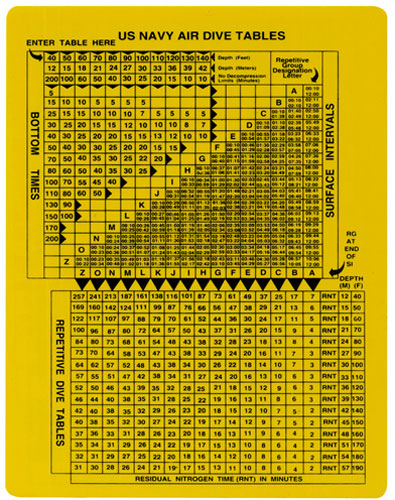
US Navy Air Dive Table 7”x9” sold by LeisurePro
Real world dive tables give AD&D a run for its money

Depth Pressure

Gas Narcosis: Occurs when divers descend too deep without the right equipment or adaptations. Can be cured quickly by returning to a lower-pressure area. If breathing compressed air, moderate symptoms kick in around 100', and by 300' progress to hallucinations, terror and death. Breathing Diver's Gas, using gills or other methods allow for deeper diving. With those methods, progress a stage along the below scale for every 300' below their listed depth.
No effect > Mild impairment > Delayed responses and overconfidence > Hysteria and hallucinations > Confusion and terror > Blackout, death

The Bends: Occurs when divers ascend too quickly. If you're not careful, trying to cure your narcosis will lead to this. After ascending more than 300' in 10 minutes, you will contract the bends. The symptoms will manifest in 1d6 hours. Roll 2d6 for the severity of the effect. For each additional 300' ascended, add +1 to the roll and subtract -1 from the time. Mild cases can be treated by returning to depth, more serious cases will require high-tech or magical cures.

2-3: Discomfort and pain, without long-term effects. 4-8: -1d4 HP and +2 fatigue. 8-10: -2d4 HP, +4 Fatigue and disorientation. 10-12: -3d4 HP, +6 Fatigue, Save vs Paralysis. 12+:  As previous, plus lung decompression, Save vs Death every minute until treated.

Fatigue: In the dusk zone and below, the effects of gas narcosis become apparent regardless of what equipment you have. Every 6 hours spent below the dusk zone without pressure suits, add 1 point of Fatigue. For every additional 300' of depth, add an additional point of fatigue each time. Spending a period below 1500' adds 1 fatigue. Descending to 1800' and spending 6 hours there adds two more, etc.

Crushing: The human body can withstand substantial atmospheric pressure. The possibility of being physically squeezed or crushed only appears well below the midnight zone. Fatigue, insomnia and fatal narcosis will occur far before physical injury from pressure becomes a real risk.


Light

Light is a substantial concern at depth. The 'Sunlight' or euphotic zone, where light penetrates easily during the day, goes down to approximately 200m, or ~600'. The 'Twilight' or dysphotic zone, where sunlight decreases rapidly with depth and photosynthesis is not possible, goes from 200-1000 meters, ~600'-3000'. Below 1000m, ~3000', you enter the 'Midnight' or aphotic zone, where no sunlight penetrates and the only sources of light are those generated by the local fauna and flora.
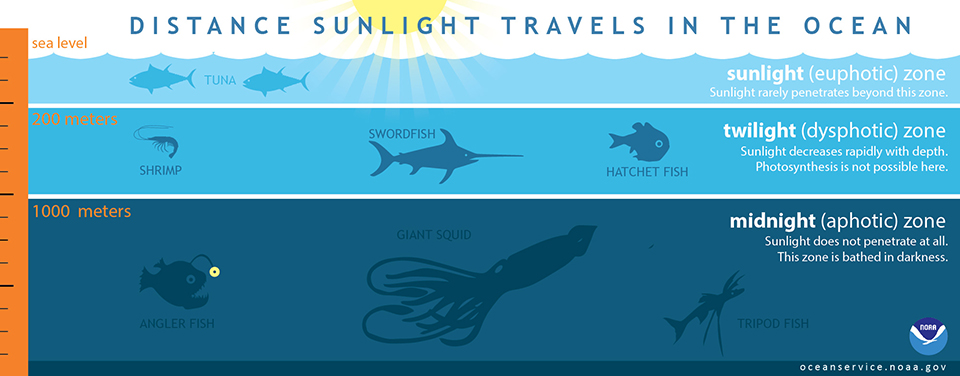
illustration of how far light travels in the ocean.

For our purposes as game/adventure designers, this provides quite a neat structure. The deeper = more dangerous assumption is already built into dungeoneering and popular consciousness. But now, depth isn't just for dungeon anymore; it's both dungeon and wilderness.

The daylight zone might be the top levels of the dungeon, where the threats are minimal and are easier to spot, but it's also like the area near a town. Underwater settlements, especially those of air-breathers accustomed to a circadian cycle, will be built here. Extended freediving is possible, and with special gas mixtures/magic humans can survive here almost indefinitely, assuming their other needs are met.

In the twilight zone (laugh it up...) sunlight becomes scarcer, visibility lowers, pressure concerns become serious, and more dangerous, alien creatures are encountered. The most experienced human freedivers can dive into the dysphotic zone, but only just. To explore this place fully, you need special equipment to combat gas narcosis. At the lower depths of this zone, the human body reaches its natural limits. Not only does gas narcosis become severe, exposure to these depths for more than a few hours produce fatigue, insomnia and hallucinations.

I split the twilight zone into the evening and dusk zones, to distinguish between the pressure effects across the zone.

In the midnight zone, there's no sunlight anymore, just whatever you or the monsters can make. Humans can't even get to the border on their own power. To breach the barrier of darkness, you need pressurized suits or submarines. The nastiest, most alien of creatures live down here. There may be uncounted treasures, or there might be nothing. It's Veins of the Earth, except a wrong move will suffocate you. The environment is utterly hostile.

Visibility

Under clear conditions, visibility underwater should be approximately 100'. In extremely clear areas near the surface, effective visibility may extend to about 150'. These figures assume both full daylight and lack of particles/pollutants. Visibility in the daylight and twilight zones takes a sharp dive at night. You can get around this with your own light sources, but particles are more challenging. Some areas are choked with algae at all times. Others are periodically blocked by sand, whipped up by currents or incautious divers. Clay is the worst. Sand will settle back down in a few minutes undisturbed, but loose clay will jump at a moment's notice, and can choke an area for hours.


Depth Pressure

Under Earth-similar conditions, you gain an additional atmosphere of pressure for every ~10m (~30'). This figure is already familiar to RPG aficionados.

How much pressure (critically, how far down) can humans survive? Surprisingly, quite a lot. The limit for recreational diving is 40m, ~120', well shy of the dysphotic zone. Between 40m and 60m is the domain of technical, non-recreational divers. Anything greater than 60m is commonly termed a deep dive. But the actual limit for human freediving goes much deeper.

The current world record holder for freediving is an Egyptian man named Ahmed Gabr, who used a scuba system to dive to a depth of 332 meters, or ~1090'. Still well shy of the aphotic zone, but getting closer. Notably, the greatest obstacle to deep diving is not pressure on the human body, crushing ribs and muscles, but the effects of pressure on internal gas exchange.

Two effects; decompression sickness, also known as the bends, and gas narcosis. Gabr's record dive took only twelve minutes to make, but he took 13 and a half hours to return to the surface. If he had risen quicker, the change in internal pressure of gases in his body would have resulted in hallucinations and drunkenness at best, death at worst.

Gas Narcosis: Occurs when divers descend too deep without the right equipment or adaptations. Can be cured quickly by returning to a lower-pressure area. The effects are similar to drunkenness. In the early stages, the diver feels empowered, masterful, euphoric, while losing minor motor and sensory function. As the narcosis progresses, the diver is subject to impaired judgment, mood swings and loss of coordination. In extreme cases, paranoia and hallucinations set in. A diver may be taken with the 'rapture of the deep' a narcotic self-confidence that drives them deeper and deeper, until they finally die.

The Bends: Occurs when divers ascend too quickly. If you're not careful, trying to cure your narcosis will lead to this. As you dive deeper, the nitrogen in your blood is absorbed into your tissues. In itself, this isn't dangerous, and when you decrease pressure, the gas is released again. But if you decrease pressure too quickly, the nitrogen will form bubbles. Your blood will literally fizz like a soda. Symptoms include joint pain, exhaustion, phantom itching and, in extreme cases, difficulty breathing, quickly leading to shock. There is no way around the bends; you have to slow your ascent, or go deeper if you already have it.
Image result for fantasy diver

Even so, if we can get past the issues of breathing and internal gas transfer, we can go a lot deeper. While Gabr's 332 meter dive is the world record, subjecting him to over thirty atmospheres of pressure, humans have survived much more. In a simulated dive inside a barometric chamber, breathing hydreliox, a mix of hydrogen, helium and less than 1% oxygen, Theo Mavrostomos survived 2 hours under seventy atmospheres of pressure, equivalent to being 701 meters or 2100' down. Much closer to the aphotic zone. This is the world record for human high-pressure survival, and this upper bound seemingly isn't related to the durability of the human body, just gas exchange.

But even though the human body isn't physically crushed at those depths, consistent fatigue and insomnia render long-term operation at those depths difficult, and likely damaging in the long run. Still, we've shown humans can at survive brief periods quite close to the aphotic zone, when narcosis and oxygen toxicity was taken care of.

I would go as far as to say that gilled humans, whether native or mutants, would be capable of diving to these depths without worrying about narcosis or DCS, but likely couldn't operate for extended periods of time without insomnia, fatigue and long term damage.

So how to we get to the aphotic zone, where all is eternal night and the greatest horrors may be found?

First off, pressurized suits. This is a fairly high-tech solution that gets around several of our depth problems, allowing humanoids to extend their operating capacity. They act effectively as heavy armor, but can be compromised. A suit losing pressure over a very short period of time is not fun. These might be magical in nature, the rare remaining construct of an advanced lost civilization, or most likely, a bit of both. Still, like heavy armor, these suits are bulky and slow.

Second, submarines. Because what's an underwater campaign without submarines? Most of the rules above assume players are moving about underwater on their own power, or possibly on a mount. PCs are exposed to depth pressure at most times, unless in a special suit or in a pressurized location. But in a fully pressurized closed vessel, there's none of that. It's like being back on land for a time. Functioning submarines exist as relics of the above long-lost civilizations. They're rare and valuable, and great loot at the end of a dungeon, if they can be fixed up.

Image result for underwater adventure

Final Comments

The gameplay potential of several of these mechanics is apparent. The Bends discourages going up, that is, to safety, too quickly. This strongly encourages planning ahead, and means the party can't just ascend to escape a nasty encounter. The four zones create clear demarcations for adventuring environments, and the players' latitude to explore them. There are no shortage of environmental obstacles in our real world oceans that can fuck up the PCs day, before factoring in any kind of combat.

The kind of game these rules create is gritty, dark, survival and logistics focused. It's Veins of the Earth underwater. The environment is hostile and strange and god knows what's down there. Survival is not at all guaranteed.

If you want an underwater adventure without those elements, where the party can explore as they please, these rules won't do that for you. For me, the main attraction of this kind of adventure is the alienness and danger. Getting around the restrictions of a place that absolutely does not want you there is the big challenge, and it means that a party that has learned to conquer the deep has truly engaged with the environment, instead of just passing through.

Note: OF COURSE I find a post on the OSR subreddit made just hours before I post this. Though it doesn't quite cover the same things. Go and check it out on Malcon's blog.